

Introduction
In the dynamic world of real estate investment, stability is the ultimate currency. While market fluctuations can create uncertainty, the U.S. government's Section 8 program presents a resilient, and often misunderstood, investment opportunity, particularly in volatile economic climates. More than a social support system, the Housing Choice Voucher (HCV) program is a robust market segment that offers a unique value proposition: government-guaranteed rental income.
This report provides a comprehensive, data-driven analysis for real estate investors, property managers, and entrepreneurs on how to navigate, manage, and profit from the Section 8 HCV program. It will demystify the process, from initial property qualification to tenant management, and quantify the distinct risks and rewards associated with it. For savvy investors and entrepreneurs looking to diversify their portfolios or develop innovative PropTech solutions, this guide illuminates how technology is the definitive key to unlocking efficiency, mitigating administrative burdens, and achieving scale in this specialized market. The following sections will guide the reader from foundational knowledge of the program's mechanics to operational mastery and the technological solutions that are reshaping Section 8 investing.
Section 1: The Section 8 Program: An Investor's Primer
1.1 Deconstructing the Housing Choice Voucher (HCV) Program
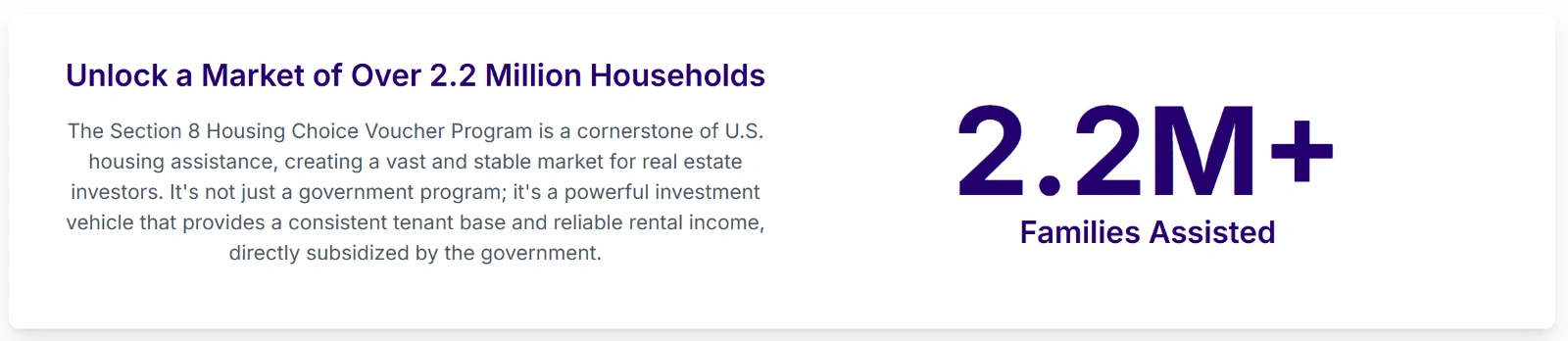
The Housing Choice Voucher (HCV) program, colloquially known as Section 8, is the federal government's primary initiative for helping low-income families, the elderly, and individuals with disabilities afford decent, safe, and sanitary housing within the private market. With a reach extending to nearly 5 million households, the program represents a significant and stable segment of the national rental market.
The program operates through a voucher mechanism administered by a local Public Housing Agency (PHA). After determining a family's eligibility, the PHA issues a voucher. The family is then responsible for finding a suitable rental unit from a private landlord who is willing to participate in the program. Once a unit is chosen and approved, the PHA enters into a contract with the landlord to pay a housing subsidy directly to them. The family then pays the difference between the actual rent charged by the landlord and the amount subsidized by the program. This direct government payment is the foundational element of the program's financial appeal to investors, as it significantly reduces the risk of rent default.
1.2 Tenant-Based vs. Project-Based Vouchers: A Strategic Comparison
Investors must understand the critical distinction between the two primary types of Section 8 assistance, as each carries different strategic implications.
- Tenant-Based (Mobile) Vouchers: This is the most prevalent form of Section 8 assistance. The voucher is assigned to the family, not the property, granting them the flexibility to choose any qualifying rental unit in any location. For an investor, this means their property competes on the open market to attract voucher-holding tenants. The primary advantage is access to a large and motivated pool of potential renters.
- Project-Based Vouchers (PBVs): In this model, the rental subsidy is attached to a specific property or unit rather than to the tenant family. If a tenant moves out of a PBV unit, the subsidy remains with the unit for the next eligible tenant. This is a crucial distinction for investors, particularly in the multifamily space. A long-term PBV contract with a PHA can guarantee a subsidized tenant base for the duration of the contract, substantially de-risking the investment and creating a highly predictable revenue stream.
The choice between targeting tenant-based or project-based vouchers depends on an investor's strategy. Tenant-based vouchers offer broader market access but require continuous effort to source and retain tenants. Project-based vouchers provide unparalleled long-term stability and are often associated with larger multifamily assets, representing a distinct investment class.
1.3 The Public Housing Agency (PHA): Your Essential Partner in Section 8 Investing
The Public Housing Agency (PHA) is the state or local government entity responsible for the administration of the HCV program. While PHAs are overseen by the U.S. Department of Housing and Urban Development (HUD), they are not federal agencies. For an investor, the PHA is the primary counterparty for both payments and compliance, making a functional understanding of their role essential.
Key responsibilities of the PHA include:
- Managing applicant waiting lists.
- Determining family eligibility and issuing vouchers.
- Approving rental units and proposed rent amounts.
- Conducting mandatory property inspections.
- Executing Housing Assistance Payment (HAP) contracts with landlords.
Crucially, there are more than 3,000 PHAs across the United States, and each possesses significant discretion in how it operates its program. This local control results in variations in payment standards, inspection schedules and stringency, required paperwork, and local preferences for prioritizing applicants. An investor with properties in two adjacent counties may find they are dealing with two different PHAs with entirely different procedures. This decentralized structure is a primary driver of the administrative complexity that characterizes Section 8 investing. It means that a "one-size-fits-all" operational playbook is impossible. Instead, an investor's processes must be agile and adaptable to the unique requirements of each PHA they work with. This fragmentation represents a significant operational challenge and highlights a critical area where specialized software can provide immense value by standardizing and managing workflows across diverse PHA systems.
Section 2: The Financial Calculus of Section 8 Investment
2.1 Analyzing the Revenue Stream: Guaranteed Payments and Rent Calculation
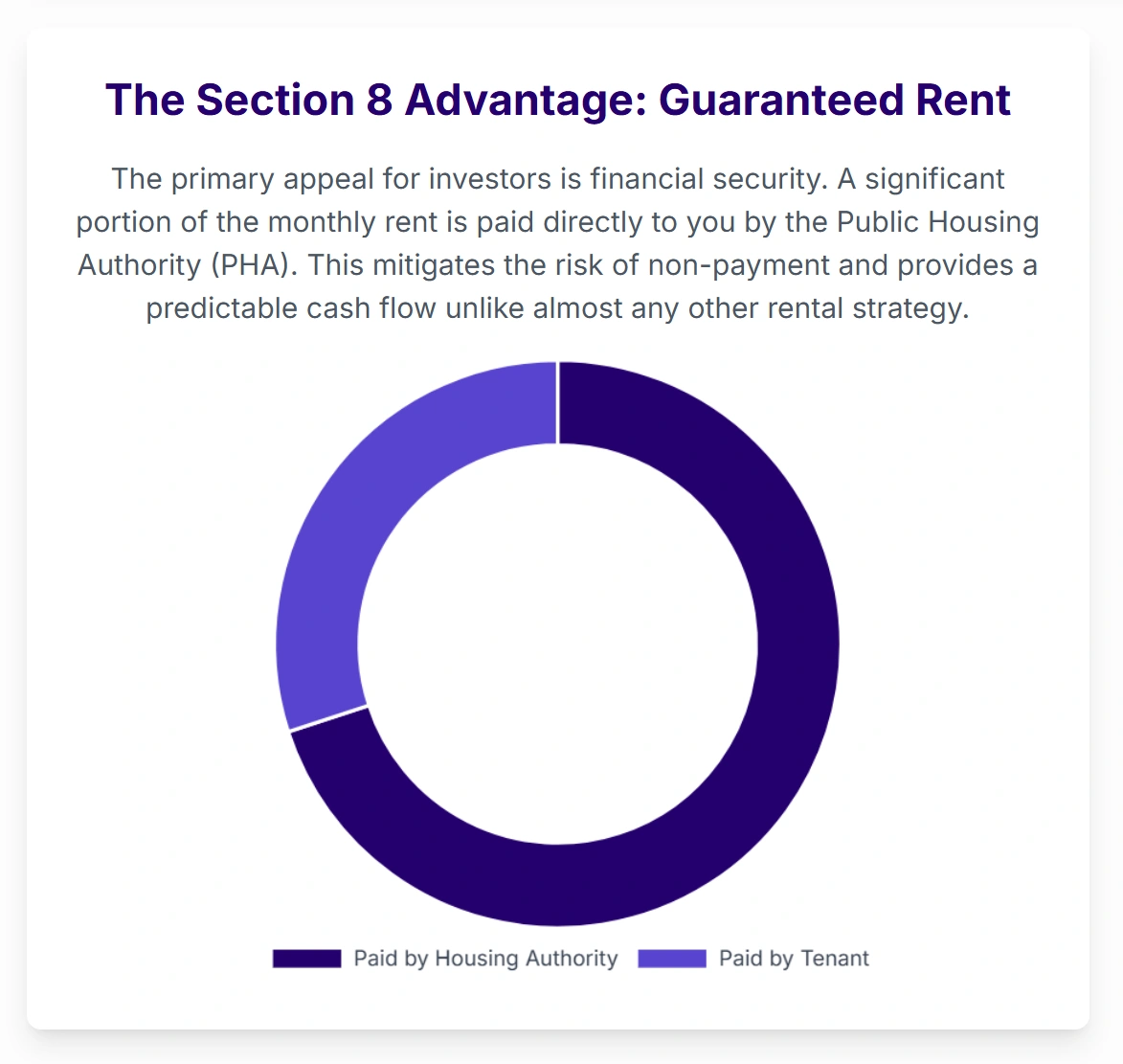
The financial stability of a Section 8 investment is anchored by the Housing Assistance Payment (HAP). This is the subsidy portion of the rent paid by the PHA directly to the landlord, typically via direct deposit on or before the first of each month. This mechanism effectively mitigates the most significant risk in residential real estate: non-payment of rent.
The tenant remains responsible for their portion of the rent, which is typically calculated as 30% of their adjusted monthly income. A key HUD regulation stipulates that a family's total payment toward rent and utilities cannot exceed 40% of their adjusted monthly income at the time of initial leasing. This structure ensures that even if a tenant is late with their share, the landlord is guaranteed to receive the larger, government-paid portion of the rent, often 70% or more. The reliability of this system was particularly evident during the COVID-19 pandemic, where many Section 8 landlords continued to receive consistent HAP payments while market-rate landlords contended with eviction moratoriums and widespread non-payment.
2.2 Understanding Fair Market Rent (FMR), Payment Standards, and Rent Reasonableness
The rental income from a Section 8 property is not arbitrary; it is governed by a set of calculations and standards established by HUD and administered by the local PHA.
- Fair Market Rent (FMR): HUD annually sets FMRs for metropolitan areas and counties across the country. The FMR is an estimate of the gross rent (rent plus tenant-paid utilities) for a modest housing unit and is typically set at the 40th percentile of local market rents. FMRs serve as the foundational baseline for the program's subsidy calculations.
- Payment Standard: The PHA uses the FMR as a guide to establish a local "Payment Standard." This figure represents the maximum monthly subsidy the PHA will pay for a rental unit of a specific bedroom size within a defined geographic area, which can be as granular as a ZIP code. This is the most critical number for an investor to know when forecasting potential revenue.
- Rent Reasonableness: Before approving a lease, the PHA must conduct a "rent reasonableness" test. This ensures that the total rent requested by the landlord is not more than the rent charged for comparable, unassisted units in the same market. An investor cannot inflate the rent simply because the unit is intended for the Section 8 program.
The final approved rent is determined by the interplay of these factors. A landlord proposes a Contract Rent. The PHA adds a Utility Allowance (an estimate of what the tenant will pay for utilities) to arrive at the Gross Rent. This Gross Rent must be deemed reasonable and is then compared against the Payment Standard to determine the final subsidy amount and tenant portion.
2.3 The Investor's Balance Sheet: A Nuanced Look at the Pros and Cons
Investing in the Section 8 program involves a clear set of trade-offs that must be carefully weighed.
Pros (The Upside):
- Predictable Rental Income: The government subsidy provides a reliable, on-time revenue stream, insulating the investor from significant default risk.
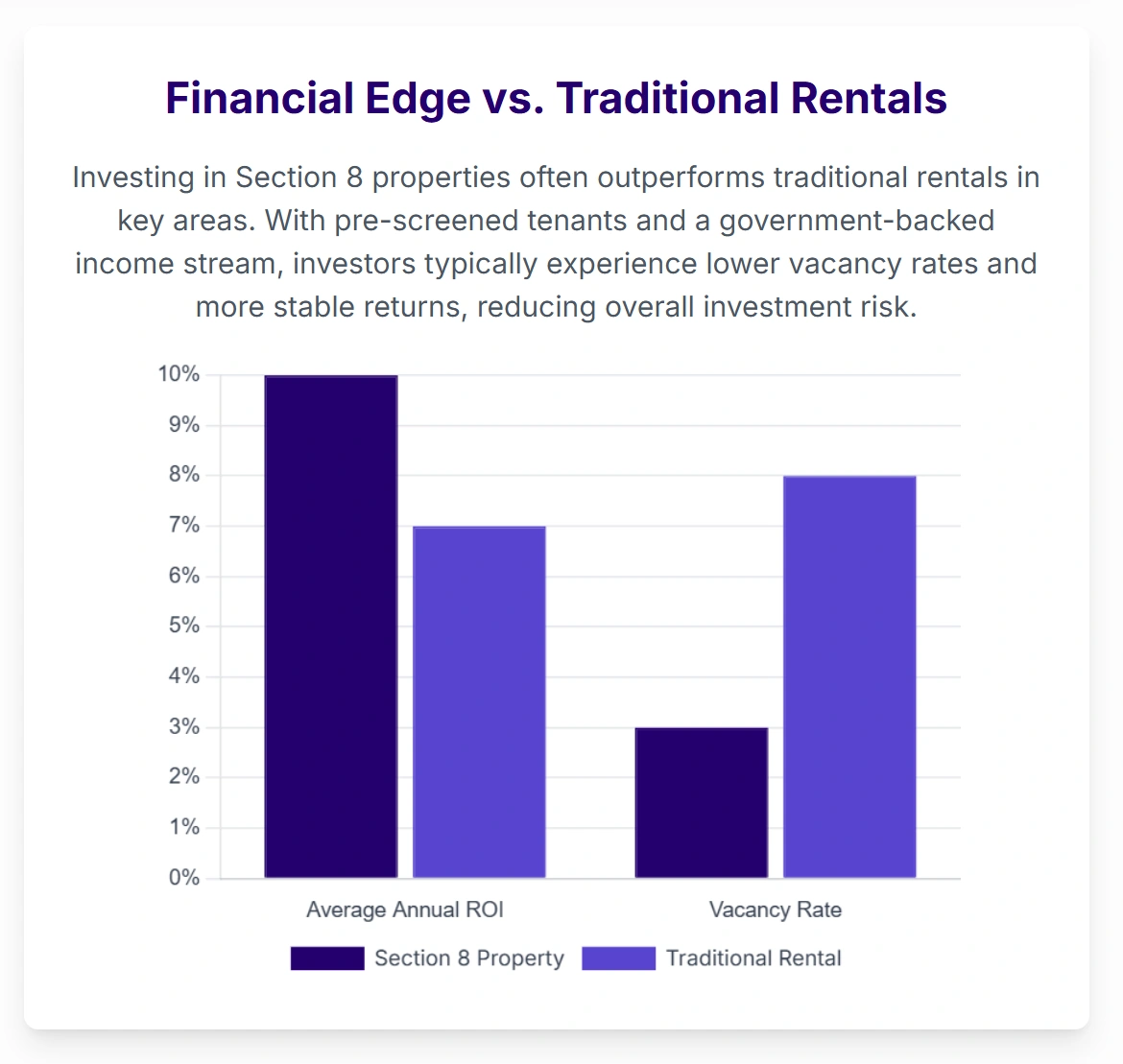
- Low Vacancy Rates: Due to high demand and long waiting lists for vouchers, Section 8 properties tend to fill up quickly. Tenants also tend to have longer tenures, which reduces costly turnover.
- Pre-Screened Tenants: The PHA conducts initial income verification and criminal background checks, providing a baseline level of tenant screening.
- Annual Rent Increases: Landlords can generally request rent increases once per year, subject to PHA approval and rent reasonableness standards.
Cons (The Downside):
- Bureaucracy and Red Tape: The administrative burden associated with paperwork, inspections, and PHA communication is the most frequently cited challenge for landlords.
- Rent Caps: Rental rates are constrained by FMRs and rent reasonableness rules, which may prevent landlords from achieving top-of-market rents, especially for high-end properties.
- Inspection Hurdles: The strict and recurring Housing Quality Standards (HQS) inspections can be a source of frustration, leading to required repairs and potential delays in payment.
- Tenant Quality Concerns: Despite PHA pre-screening, some landlords report higher rates of property damage and lease violations compared to market-rate tenants.
- Delayed Initial Payments: Due to administrative processing, the first HAP payment can be delayed by 30 to 60 days, or sometimes longer, requiring the investor to have sufficient cash reserves.
This balance of pros and cons reveals a fundamental business trade-off. Investors in the Section 8 program are essentially exchanging the potential for higher, market-rate rental income for a lower-risk, government-guaranteed revenue stream. However, this exchange is not free. The "premium" paid for this revenue insurance comes in the form of increased operational complexity, administrative overhead, and regulatory compliance. This reframes the path to success in Section 8 investing: it is not merely a real estate acquisition challenge but an operational efficiency challenge. The key to maximizing returns lies in mastering the operational side to minimize the "premium" paid in time and effort, a problem for which technology offers a powerful solution.
Section 3: Navigating the Path to Participation: A Step-by-Step Landlord Guide
Becoming a participating landlord in the Section 8 program is a structured process that involves engagement with the PHA, thorough documentation, and diligent tenant screening.
3.1 Initial Engagement: From Property Registration to Finding Your First Voucher Holder
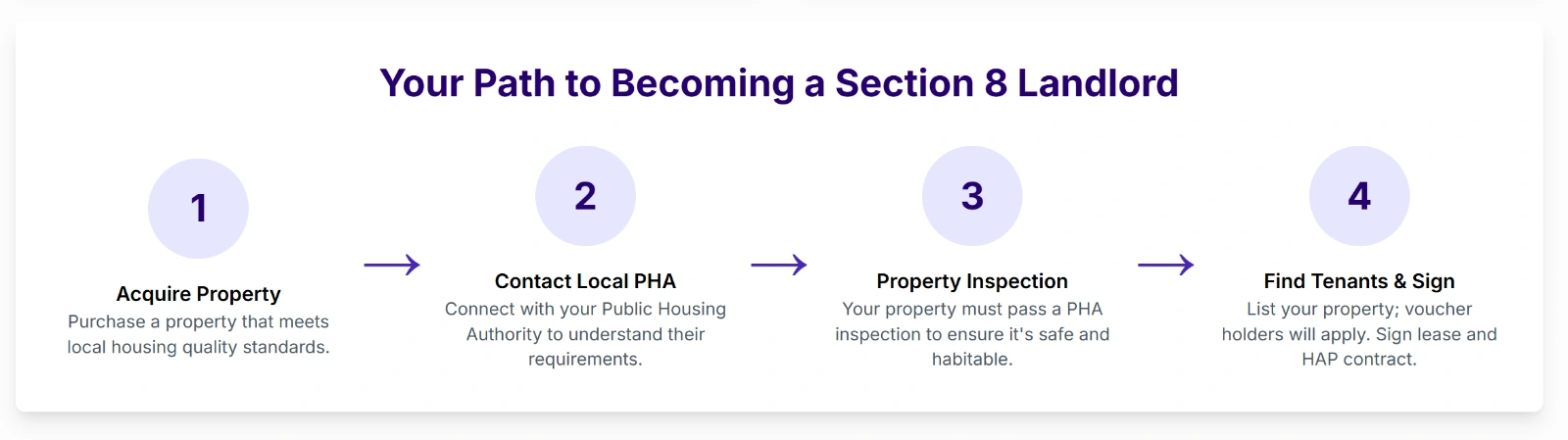
The journey begins with establishing a relationship with the local Public Housing Agency (PHA). The first step for any property owner is to contact the PHA in the jurisdiction where the property is located to understand their specific landlord requirements, application procedures, and any necessary property registration protocols. Once prepared, landlords can advertise their units as "Section 8 accepted" or "HCV welcome." Many PHAs facilitate this by offering free online listing platforms where landlords can post vacancies directly to voucher holders. The process is typically initiated when an eligible tenant, who has already been issued a voucher by the PHA, finds the property and presents their program paperwork to the landlord.
3.2 The Paper Trail: Mastering the Request for Tenancy Approval (RFTA) and Key Documents
The formal process begins with the completion of the Request for Tenancy Approval (RFTA) packet. This is the core set of documents, filled out by both the landlord and the prospective tenant, that details the specifics of the unit, the proposed rent, and the allocation of utility responsibilities.
Alongside the RFTA, landlords must be prepared to submit a portfolio of essential documentation to the PHA. While specific requirements can vary by agency, the typical submission includes:
- Proof of Ownership: A copy of the property's deed.
- Tax Information: A completed W-9 form for tax reporting purposes.
- Lease Agreement: A copy of the unexecuted lease that will be used for the tenancy.
- Lead-Based Paint Disclosure: A mandatory form for any property constructed before 1978.
- Banking Information: Details for direct deposit of HAP payments.
- Proof of Insurance: Evidence of appropriate property insurance coverage.
3.3 Due Diligence: The Landlord's Role in Tenant Screening
A common and costly misconception is that the PHA's screening process is sufficient for tenant selection. It is critical for investors to understand that the PHA screens applicants for program eligibility, based on income and other federal criteria, not for tenant suitability. The PHA does not act as a property manager or guarantor of tenant behavior.
Therefore, the responsibility for thorough tenant screening rests entirely with the landlord. Landlords must conduct their own comprehensive due diligence process, just as they would for any market-rate applicant. This process should include credit checks, rental history verification, reference checks, and criminal background screening, all while adhering strictly to Fair Housing laws. This step is the landlord's primary tool for risk mitigation and is essential for a successful Section 8 investment experience.
3.4 Finalizing the Partnership: The HAP Contract and Lease Agreement
After the landlord selects a tenant and submits the complete RFTA packet, the PHA undertakes its final review. The agency assesses the proposed rent for affordability and reasonableness against local market data. Once the paperwork is provisionally approved, the PHA schedules the mandatory Housing Quality Standards (HQS) inspection, which the unit must pass before the process can continue.
Upon a successful inspection and final approval of the rent, two key legal documents are executed:
- The Housing Assistance Payments (HAP) Contract: This is a three-party agreement between the landlord, the tenant, and the PHA. It is the legal instrument that guarantees the direct subsidy payments from the PHA to the landlord and outlines the responsibilities of each party under the program.
- The Lease Agreement: This is a standard lease between the landlord and the tenant. It must incorporate a HUD-mandated tenancy addendum that includes program-specific clauses. The landlord is solely responsible for enforcing the terms of this lease.
Section 4: Mastering Compliance: A Deep Dive into Housing Quality Standards (HQS)
Compliance with HUD's Housing Quality Standards (HQS) is non-negotiable for participation in the Section 8 program. These standards are designed to ensure that all subsidized housing is "decent, safe, and sanitary," and a property must pass an HQS inspection before any HAP payments can be issued.
4.1 The HQS Inspection: Purpose, Process, and Potential Outcomes
The HQS inspection is a physical evaluation of the property conducted by a PHA inspector. Inspections occur at several key junctures:
- Initial Inspection: Before a new tenant moves in.
- Annual/Biennial Inspection: On a recurring basis (typically every one or two years) to ensure continued compliance.
- Special Inspection: Triggered by a complaint from the tenant or landlord regarding a potential health or safety issue.
During the inspection, each item on a detailed checklist is evaluated and assigned one of three outcomes:
- Pass: The item meets HQS requirements.
- Fail: The item has a deficiency. If even one item fails, the entire unit fails the inspection. The landlord is then given a specific timeframe to make corrections—typically 24 hours for life-threatening issues (like a gas leak) and up to 30 days for non-critical issues. Failure to correct deficiencies in a timely manner can lead to the abatement (suspension) of HAP payments.
- Inconclusive: The inspector could not verify compliance, often due to an inability to access a specific area (e.g., a locked electrical panel). This requires follow-up.
4.2 A Room-by-Room Breakdown of HQS Requirements
The HQS checklist is extensive, covering every aspect of the property. The standards are based on ensuring the health, safety, and livability of the unit. Key areas of focus include:
- General Health & Safety: This is the most critical category. It mandates working smoke detectors (and carbon monoxide detectors where applicable), secure locks on all exterior doors and windows, the absence of pest infestations, and adherence to lead-based paint regulations for homes built before 1978.
- Living Spaces (Living Room, Bedrooms): Each bedroom must have at least one window for egress and ventilation. All living areas must have adequate electrical service (e.g., two outlets or one outlet and a permanent light fixture), and the walls, floors, and ceilings must be structurally sound and free of hazardous defects.
- Kitchen: The kitchen must be equipped with a sink providing hot and cold running water, a stove or range with all burners operational, and a refrigerator in proper working condition.
- Bathroom: The unit must contain a separate, private room with a flush toilet, a fixed wash basin, and a shower or bathtub. All fixtures must have hot and cold running water and proper ventilation (either an opening window or an exhaust fan).
- Systems (Electrical, Plumbing, HVAC): The property's core systems must be safe and functional. This includes no exposed wiring, no plumbing leaks, and a permanently installed, adequate heat source capable of maintaining a habitable temperature
4.3 Common Fail Points and How to Proactively Address Them
While the HQS checklist is long, a recurring set of issues accounts for a large percentage of inspection failures. Proactive investors can use this knowledge to pre-inspect their properties and avoid costly delays. The most common deficiencies include:
- Inoperable or missing smoke detectors.
- Peeling or chipping paint (a major issue in pre-1978 homes due to lead paint risk).
- Missing or cracked electrical outlet cover plates.
- Broken or non-locking windows on the ground floor.
- Missing or insecure handrails on stairs (both interior and exterior).
- An improper or missing discharge pipe on the water heater's temperature pressure relief valve.
A savvy investor treats the HQS checklist not as a hurdle, but as a standard operating procedure. It should be used as a pre-acquisition due diligence tool and as the foundation for a preventative maintenance plan to ensure properties remain in compliance at all times.
Table 1: Comprehensive Housing Quality Standards (HQS) Checklist
The following table synthesizes the key requirements from HUD guidelines and PHA checklists into a single, actionable tool for property owners and managers. Use this to conduct pre-inspections and prepare for official HQS reviews.
| Inspection Area / System | Key Requirement | Pass / Fail Criteria |
|---|---|---|
| Living Room | Must be present and provide adequate space. |
Pass Room exists and is structurally sound.
Fail Lack of a living room, severe structural damage.
|
| Kitchen | Must have a sink with hot/cold water, an oven, and a stove/range. |
Pass All appliances are present and functional.
Fail Missing or non-operational oven, stove, or sink.
|
| Bathroom | Must have a flush toilet, a fixed wash basin with hot/cold water, and a tub or shower. Must provide privacy. |
Pass All fixtures work, no leaks, and a lockable door exists.
Fail Non-working toilet, no hot water, no door.
|
| Electricity & Illumination | Each room must have adequate natural or artificial illumination. At least two working outlets or one outlet and one fixed light fixture. |
Pass No exposed wiring, all outlets/switches are safe and working.
Fail Exposed/frayed wires, non-working outlets, insufficient lighting.
|
| Structure & Materials | Ceilings, walls, and floors must be free of hazardous defects. Roof must be structurally sound and weatherproof. |
Pass No large holes, cracks, or signs of water damage/leaks.
Fail Actively leaking roof, buckled floors, significant structural damage.
|
| Windows | All windows must be intact, without cracks or breaks, and lockable if accessible from the outside. |
Pass Glass is intact, windows open/close, and locks function.
Fail Broken or missing panes, windows sealed shut, broken locks.
|
| Lead-Based Paint | In units built before 1978 where a child under 6 resides, all painted surfaces must be free of chipping, peeling, or flaking paint. |
Pass All painted surfaces are smooth and intact.
Fail Any evidence of deteriorated paint on any surface.
|
| Heating & Plumbing | Heating system must be safe and capable of maintaining an adequate temperature. Plumbing must be free of leaks. |
Pass Heater functions safely, no gas smells, no visible water leaks.
Fail Inoperable heating system, active plumbing leaks.
|
| Safety & Security | Working smoke detectors on each level. All exterior doors must be secure and lockable. |
Pass Smoke detectors are present and functional. Doors have working locks.
Fail Missing or non-functional smoke detectors, broken door locks.
|
| Sanitary Conditions | The unit must be free from vermin, rodent infestation, and excessive garbage or debris. |
Pass No visible signs of pests (e.g., droppings, nests) or major sanitation issues.
Fail Evidence of active infestation or hazardous sanitary conditions.
|
Section 5: The Operational Realities: Managing Administrative Burden and Maximizing ROI
While the financial structure of Section 8 is appealing, the day-to-day operational realities present significant challenges. Success in this sector depends heavily on an investor's ability to efficiently manage these complexities.
5.1 The "Red Tape" Challenge: Navigating PHA Bureaucracy and Communication Gaps
The single most significant pain point cited by landlords is the administrative burden and the difficulty of communicating effectively with PHAs. Anecdotal evidence from landlord forums is replete with stories of hours spent on hold, unreturned voicemails, and slow processing times that delay tenancy and payments. This friction stems from a combination of factors, including the sheer volume of paperwork required for every step of the process - from initial tenancy approval to annual recertifications, rent increase requests, and changes of ownership.
The single most significant pain point cited by landlords is the administrative burden and the difficulty of communicating effectively with PHAs. Anecdotal evidence from landlord forums is replete with stories of hours spent on hold, unreturned voicemails, and slow processing times that delay tenancy and payments. This friction stems from a combination of factors, including the sheer volume of paperwork required for every step of the process - from initial tenancy approval to annual recertifications, rent increase requests, and changes of ownership.
It is important to recognize that PHAs are often underfunded, understaffed public agencies tasked with administering complex federal regulations, which contributes to these inefficiencies. Some PHAs are making good-faith efforts to improve landlord relations by creating dedicated liaison positions or collaborating with neighboring agencies to standardize forms and procedures. However, the fundamental problem persists. The communication breakdown is not merely about unresponsiveness; it is the systemic lack of a centralized, transparent platform for information exchange. Landlords are frequently left in an information vacuum, unable to get real-time status updates on inspection results, payment processing, or paperwork approval. This inability to access timely information prevents them from making critical business decisions, such as when to schedule repairs or initiate legal proceedings. The root issue is the absence of a shared, real-time "single source of truth" for the landlord-PHA relationship - a classic business process problem that modern software is uniquely equipped to solve.
5.2 Inspection Delays and Tenant Management: Mitigating Common Frustrations
The HQS inspection process, while necessary, is a major source of frustration and a frequently cited barrier to landlord participation in the program. Landlords report wide, inconvenient appointment windows (e.g., 8 AM to 5 PM) and even no-shows by inspectors, which cost them a full day of productivity and can delay a tenant's move-in, resulting in lost rent.
Tenant management also presents unique challenges. Landlords must deal with tenants who may inadvertently cause inspection failures, for example, by disabling smoke detectors or blocking fire escapes. Furthermore, some landlords report that Section 8 tenancies can result in greater wear and tear on a property, necessitating more frequent and costly repairs. The eviction process can also be more complex, as it may require additional steps such as notifying the PHA and participating in a grievance hearing, which can prolong the timeline for removing a non-compliant tenant. Finally, landlords must be vigilant for and report instances of tenant fraud, such as unreported income or unauthorized residents living in the unit, which can jeopardize the tenancy and the landlord's standing in the program.
Section 6: The PropTech Advantage: Streamlining Section 8 with Specialized Software
The significant administrative and compliance challenges detailed in the previous section represent a clear opportunity for technological intervention. Property technology, or PropTech, offers a strategic solution to transform the high-friction, paper-based processes of Section 8 management into streamlined, efficient, and scalable operations.
6.1 Transforming Administrative Burden into Operational Efficiency
The core value proposition of specialized software for Section 8 investors is its ability to automate, centralize, and streamline the program's complex workflows. Instead of relying on a patchwork of paper forms, phone calls, and spreadsheets, a modern software platform provides an integrated system to manage every aspect of the landlord-PHA-tenant relationship. This shift from manual to automated processes directly addresses the primary pain points of bureaucracy and communication gaps, allowing investors to focus on portfolio growth rather than paperwork.
6.2 Core Software Features for the Modern Section 8 Investor
An effective real estate software solution designed for the Section 8 market must include a specific set of features tailored to the program's unique demands. Based on an analysis of existing affordable housing platforms, these are the essential components:
- Automated Compliance & Recertification Tracking: The system should function as a compliance engine, automatically tracking critical deadlines for annual tenant recertifications, HQS inspections, and lease renewals. It should generate automated alerts for staff to ensure no deadline is missed. Furthermore, the software must be updated to reflect changes in HUD regulations, such as the Housing Opportunity Through Modernization Act (HOTMA), to maintain compliance.
- Centralized Document Management: A secure, cloud-based repository for all program-related documents is essential. This includes HAP contracts, lease agreements, inspection reports, RFTAs, and tenant correspondence. This digital hub eliminates physical paperwork, reduces the risk of lost documents, and provides one-click access to an audit-ready file for any property.
- Integrated Financials and Subsidy Tracking: A robust accounting module is needed to handle the program's dual payment structure. The software should automatically track and reconcile the separate payments from the PHA (the HAP subsidy) and the tenant, providing clear, accurate financial statements and reports.
- Landlord/PHA Portal: A dedicated portal serves as the "single source of truth" that solves the critical communication gap. This platform should allow for secure messaging, electronic submission of forms with e-signature capabilities, and real-time status updates on inspections, payments, and document approvals.
- Inspection & Maintenance Workflow Management: The software should include tools to digitize the HQS checklist for pre-inspections. When a deficiency is noted, the system should be able to automatically generate a work order, assign it to maintenance staff or a vendor, and track the repair to completion. This ensures the property is always prepared for official inspections and that a clear record of all repairs is maintained.
- Waitlist and Application Management: For larger operators, features to manage applicant waiting lists, process digital applications, and track applicant status in a manner compliant with Fair Housing regulations are invaluable.
Section 7: Case Study: Building the "Section 8 Pro" Platform for Tom Cruz
7.1 The Challenge: Scaling a Section 8 Portfolio in a Competitive Market
Real-world investor Tom Cruz faced the exact challenges endemic to the Section 8 market. To successfully scale his portfolio of voucher-backed rentals in Florida, he needed a systematic way to overcome several critical hurdles: identifying viable investment properties in a competitive market, managing the complex compliance requirements across multiple units, and operating with an efficiency that would allow for profitable growth. His situation exemplified the need for a solution that went beyond generic property management software.
7.2 The LegioSoft Solution: Developing an All-in-One Ecosystem
As a development partner with deep expertise in real estate technology, LegioSoft was engaged to create a bespoke solution tailored to these specific needs. The result was "Section 8 Pro," a platform conceived not merely as a piece of software, but as a comprehensive "software + training ecosystem". This approach reflects a core understanding that success in this niche requires both powerful tools and specialized knowledge. LegioSoft's role was to translate the complex, on-the-ground realities of Section 8 investing into a streamlined, intuitive, and powerful technological platform.
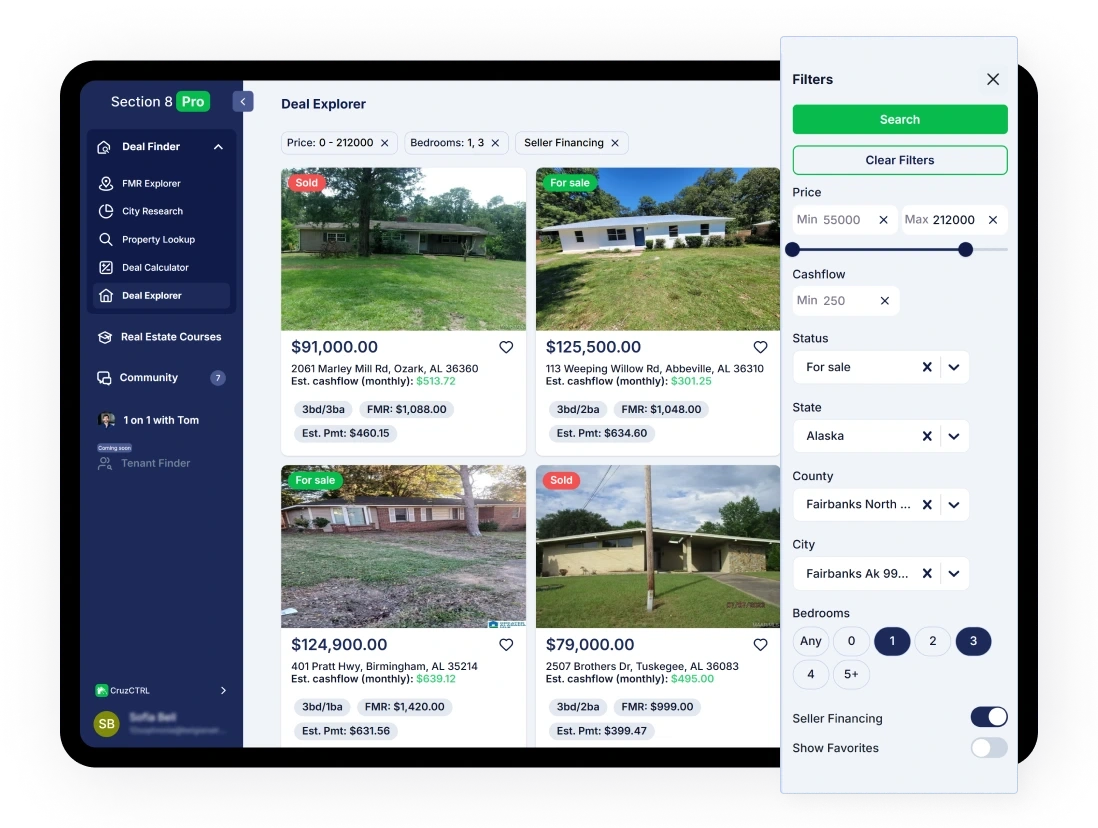
7.3 Key Features in Action: The "Deal Finder" and "CruzCTRL" Management Dashboard
The Section 8 Pro platform directly addresses the full lifecycle of a Section 8 investment through its two primary components:
- Deal Finder: This proprietary software module was built to solve the acquisition challenge. It provides investors with a powerful tool to scan property listings across various markets, applying filters specific to Section 8 investment criteria like potential cash flow, rent reasonableness, and even seller financing opportunities. This feature automates and accelerates the crucial first step of finding viable deals.
- CruzCTRL: This is the operational core of the platform, a lightweight but highly effective property management dashboard. It provides the essential tools for tracking tenants and rent payments (both the HAP and tenant portions), managing documents, and streamlining communication. CruzCTRL was designed specifically to mitigate the administrative burden that bogs down so many Section 8 landlords.
The platform also integrates an extensive library of video tutorials and provides access to a community of fellow investors. This educational layer ensures that users can leverage the software's tools effectively, reducing common errors and accelerating their path to success.
7.4 The Result: Demonstrating ROI Through Technology
The development of Section 8 Pro demonstrates the tangible return on investment that specialized technology provides. By integrating deal discovery, analysis, and operational management into a single, cohesive platform, the software delivers clear business outcomes. Investors using the system can achieve faster and more accurate deal analysis, streamlined day-to-day management, a significant reduction in administrative errors and compliance risks, and ultimately, the ability to scale their investment portfolio with a level of confidence and efficiency that is unattainable through manual processes. This case study serves as a definitive proof point for the value of custom-built real estate software.
View the Web Platform Case and Mobile Application Case
Section 8: Conclusion
8.1 Synthesizing the Opportunity, Risks, and Technological Solutions
Investing in the Section 8 Housing Choice Voucher program presents a compelling proposition: a stable, predictable revenue stream backed by the U.S. government. This opportunity, however, is balanced by a significant degree of operational complexity. The challenges of navigating PHA bureaucracy, mastering stringent HQS compliance, and managing communication across multiple stakeholders are substantial and represent the primary barriers to entry and scale.
While these hurdles are significant, they are not insurmountable. The analysis presented in this report demonstrates that the core problems of Section 8 management - disparate information, manual processes, and communication gaps - are precisely the kinds of problems that technology excels at solving. Modern, specialized PropTech is the critical enabler that transforms a high-friction investment class into a scalable, efficient, and highly manageable operation. It is the bridge between the program's potential and the investor's profit.
8.2 Your Path to Section 8 Success with LegioSoft
Just as we empowered Tom Cruz with the Section 8 Pro platform, LegioSoft can build the custom real estate software you need to dominate your investment niche. Whether you are a property manager overseeing a growing portfolio, an investor seeking to optimize operations, or an entrepreneur aiming to build the next great PropTech tool, our expertise in developing sound, stable, and highly functional real estate software provides a distinct competitive advantage.
Contact LegioSoft today to discuss your project and learn how we can turn your real estate vision into a technological reality.
Scale Your Section 8 Portfolio with Custom Software
Managing one Section 8 property is feasible. Managing dozens is a complex challenge requiring automation for inspections, compliance, payment tracking, and communication. Generic property management software doesn't cut it. You need a prop-tech solution built for the unique demands of government-assisted housing.
This is where LegioSoft excels.
We partnered with Florida's real estate expert, Tom Cruz, to develop Section 8 Pro, a bespoke software platform that streamlined his entire operation. It automates compliance, simplifies payment reconciliation, and manages communication, turning complexity into a competitive advantage.
Build Your Real Estate Software with Us