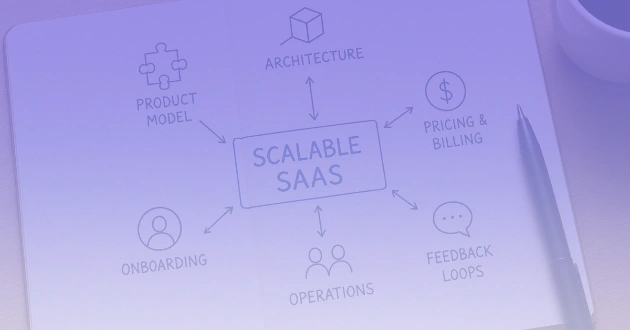

Most MVPs are not designed to scale — and that is entirely rational. Early systems are built to validate assumptions, not to withstand sustained growth. The real issue begins when teams assume that what works at small scale can be gradually extended into a high-load system without fundamental change.
In practice, this transition is rarely smooth. Scaling is not a technical upgrade; it is a shift in architecture, operations, and decision-making. Many products fail at this stage not because demand is insufficient, but because the system cannot evolve under pressure.
When Growth Exposes Structural Limits
In early stages, speed dominates. Teams prioritize iteration, often accepting shortcuts that are entirely justified at the time. Monolithic codebases, shared databases, and minimal observability are not poor decisions — they are efficient responses to uncertainty.
The challenge emerges when usage grows faster than the system’s ability to adapt. At that point, scaling stops being about handling more traffic and becomes a question of managing complexity.
A common misconception is that scaling is primarily an infrastructure problem. In reality, infrastructure issues tend to reveal deeper weaknesses in system design and data handling. Increasing server capacity rarely fixes tightly coupled components or inefficient data access patterns.
Architecture Must Reflect Variability
Most MVPs rely on a single deployable unit. This simplifies development and accelerates delivery, but it also creates hidden dependencies. As the system grows, these dependencies begin to constrain both performance and team productivity.
Different parts of the system rarely scale in the same way. Some components become read-heavy, others require intensive computation, and some must maintain strict consistency. A single architecture cannot efficiently handle all of these demands.
The transition to a scalable system requires intentional separation of concerns. This does not mean rushing into microservices. Premature decomposition often increases operational overhead without solving core problems.
A more effective approach is gradual modularization. Clear domain boundaries are defined, and only the parts of the system under real pressure are isolated. In many cases, a well-structured modular monolith provides more stability than an overly fragmented system.
The Data Layer Becomes the First Constraint
Scaling issues often surface in the database, but they originate much earlier. MVPs typically rely on a single relational database with normalized schemas and synchronous access patterns. This works well until concurrency increases.
As load grows, the database becomes a bottleneck not because it is underpowered, but because it was not designed for distributed access. Slow queries, lock contention, and cascading latency are common symptoms.
Addressing this requires a shift in how data is modeled and accessed. Read-heavy workloads can be separated from write operations. Caching can reduce repeated queries. Selective denormalization can eliminate expensive joins.
One of the less obvious realities is that database performance is often limited by query discipline rather than hardware. Poorly structured queries can degrade performance regardless of infrastructure investment.
Reliability Is Built, Not Inherited
An MVP is successful if it works. A high-load system is successful if it fails predictably and recovers quickly.
Reliability does not emerge from scaling infrastructure. It requires deliberate investment in visibility and operational practices. Many early systems lack meaningful logging, metrics, and tracing. This is manageable at low scale but becomes a critical weakness under load.
As complexity increases, teams need to understand not only that something failed, but why. This requires monitoring systems that reflect real user experience, not just internal metrics. It also requires clear processes for incident response.
Adding more data is not the solution. The goal is actionable insight. Without it, even small failures can take disproportionate time to resolve.
Performance Comes with a Cost
Every optimization introduces complexity. Caching, asynchronous processing, and data partitioning all improve performance, but they also create new failure modes and complicate consistency.
This creates a tension that many teams underestimate. Optimizing too early leads to rigid systems that are difficult to change. Optimizing too late leads to systems that are difficult to operate.
The practical approach is to treat performance improvements as responses to measured constraints. Instead of redesigning the entire system, teams focus on the most critical bottleneck at any given time.
This incremental approach reduces risk, but it requires discipline. Not every performance issue justifies a structural change.
Systems Scale Only When Ownership Scales
Technical complexity is only part of the challenge. As systems grow, the way teams work must evolve as well.
An MVP can be maintained by a small group with shared context. High-load systems require clear ownership boundaries. Without them, coordination overhead increases and reliability declines.
When responsibilities are unclear, issues tend to fall between teams. This is especially problematic in distributed systems, where failures often span multiple components.
Aligning team structure with system architecture becomes essential. Each component needs clear accountability for both development and operations. Documentation also becomes more critical, but it must reflect how the system actually behaves, not how it was originally designed.
At some point, the question shifts from whether the system can handle more users to whether it can continue to evolve without accumulating risk. This is where many teams hesitate — continuing to extend the MVP because it still “works,” even as the cost of change quietly increases.
Scaling, in this sense, is less about adding capacity and more about regaining control. It requires knowing when to stop extending what exists and start reshaping the foundation beneath it.