
As a business leader, you are constantly navigating a sea of technological buzzwords. The real challenge isn't just keeping up; it's understanding which trends truly matter for your business and how to transform them into a tangible competitive advantage. You need a clear, strategic path forward, not just more noise.
This article is designed to be that guide. We will cut through the hype to deliver a business playbook for innovation, efficiency, and growth in 2025. The core message is this: the most successful businesses will be those that move beyond simply adopting technology and instead integrate it strategically into their core operations. This is especially true for Artificial Intelligence, which has evolved from an optional tool into a structural force that is actively rewriting business strategy.
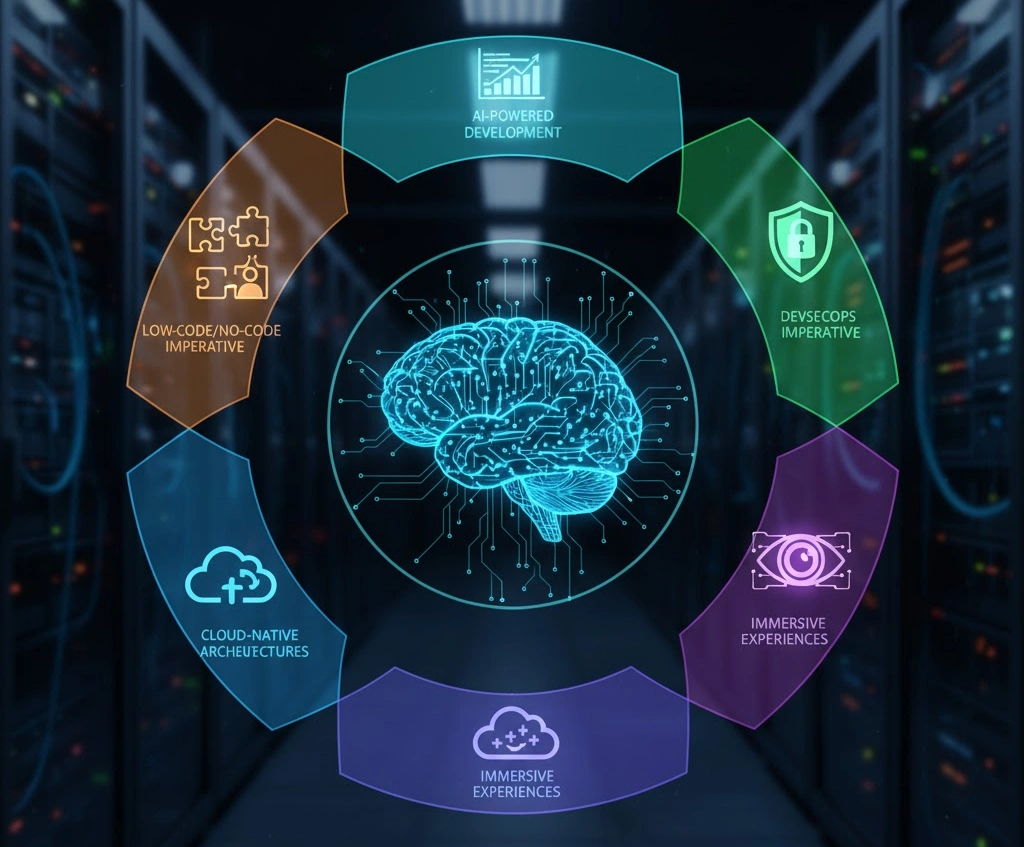
We will explore five interconnected software development trends that form the pillars of modern business strategy. Think of them not as isolated technologies, but as a holistic framework for building a more agile, secure, and intelligent organization:
- AI-Powered Development: The rise of the intelligent "co-pilot" that supercharges your teams.
- Low-Code/No-Code: The democratization of innovation, empowering everyone to build solutions.
- The DevSecOps Imperative: Building unbreakable trust through foundational security.
- Cloud-Native Architectures: The essential blueprint for agility and infinite scale.
- Immersive Experiences: The new frontier of customer engagement that blurs digital and physical worlds.
1. The AI Co-Pilot – Supercharging Development and Business Operations
Artificial Intelligence is no longer a futuristic concept; it is an indispensable part of the modern toolkit. The integration of AI into the software development lifecycle is the new standard, with an incredible 90% of software professionals now using AI tools in their daily work. This ranges from AI-assisted development tools like GitHub Copilot, which offer contextual code suggestions and automate testing, to the more advanced practices of MLOps (Machine Learning Operations), which provide the framework to build and scale AI reliably. The true paradigm shift for 2025, however, is the leap to Agentic AI—autonomous agents that can understand a goal, create a plan, and execute it with minimal human intervention.
The business imperative is clear: radical efficiency. Developers using AI assistance complete tasks 30-50% faster, translating directly into a faster time-to-market for new products and services. This strategic advantage is why over 70% of companies now use Generative AI in at least one business function. The economic scale is staggering, with projections indicating AI could contribute over $15.7 trillion to the global economy by 2030. To begin, leaders should start with internal, "safe-to-fail" pilots, like using AI to summarize reports or handle initial customer support queries. It's also crucial to establish a clear, responsible-use policy to govern the use of AI tools and invest in AI Governance Platforms to ensure ethical, secure, and transparent operation.
2. The Rise of the Citizen Developer – How Low-Code/No-Code Unlocks Innovation
Low-Code/No-Code (LCNC) platforms are shattering the paradigm that only specialized developers can create software. Using intuitive, visual interfaces, LCNC empowers non-technical business users – or "citizen developers" – to build and automate applications to solve their own departmental problems. This movement is widespread, with a remarkable 41% of employees now being "business technologists" building tech capabilities outside of traditional IT.
LCNC directly addresses the persistent shortage of technical talent and the relentless demand for faster innovation. With a global shortage of skilled workers projected to reach 85.2 million by 2030, LCNC allows organizations to increase their development capacity without adding engineering headcount. These platforms can slash application development time by as much as 90%, a key reason why Gartner predicts that by 2025, 70% of all new enterprise applications will be developed using LCNC technologies. To start, identify a low-risk internal process for a pilot project, like automating vacation requests. As adoption grows, establish a Center of Excellence (CoE) to provide guardrails and best practices, and reposition the IT department to focus on building the complex, mission-critical systems and APIs that citizen developers can leverage as building blocks.
LCNC is a perfect solution for simple applications with minimum functionality. However, it is not meant to replace traditional software development for every use case.
3. Building a Digital Fortress – Why DevSecOps is Non-Negotiable
In today's digital economy, trust is the ultimate currency. DevSecOps represents a fundamental shift that embeds security into the very fabric of the development process. The core philosophy is "Shift-Left," which means moving security practices from the end of the development pipeline to the very beginning. This is achieved through a high degree of automation, with tools integrated into the CI/CD pipeline to scan code for vulnerabilities as it's written automatically. This proactive approach is gaining traction, with 70% of security professionals reporting that their organizations have begun to shift security left.
Investing in DevSecOps is a pillar of financial risk management. The global average cost of a data breach has reached a staggering $4.5 million. A mature DevSecOps practice actually accelerates software delivery by catching and fixing security issues early, when they are cheap and easy to resolve, preventing costly delays before a product launch. This strategic importance is reflected in the market's projected growth to over $37 billion by 2035. Implementing DevSecOps requires a cultural transformation focused on shared responsibility. Leaders should start by breaking down organizational silos, investing in a consolidated toolchain to reduce complexity, and providing cross-functional training to build a shared foundation of security knowledge.
4. The Modern Blueprint – Building for Scale, Avoiding Lock-in with Cloud-Native Architectures
Being "cloud-native" isn't about simply moving your software to a cloud server; it's about building it to thrive there. Think of it as designing a race car specifically for the track, not just putting slick tires on a family sedan. This modern approach uses technologies like microservices and containers to build applications that can scale up for a traffic spike in seconds and scale back down just as fast. The business benefit is pure agility — the power to launch new features quickly and handle any amount of customer demand without breaking a sweat.
But here's the critical warning we give every client: The cloud offers immense power, but it can also be a gilded cage. Without a clear strategy, the pay-as-you-go model can quickly turn into a blank check, leading to shocking overcosts. More importantly, relying too heavily on the proprietary tools of a single provider like AWS, Azure, or Google Cloud leads to vendor lock-in. You lose your negotiating power, and your architecture becomes beholden to their roadmap and pricing. It's a strategic trap that can stifle growth and drain budgets.
The smart play is to design for flexibility from day one. A proper cloud-native strategy means keeping your options open, ensuring you can move between providers if a better deal or better technology comes along. It's about using the cloud's power on your terms, not theirs, by always keeping a close eye on costs and avoiding architectural dead ends.
5. The New Customer Reality – Crafting Immersive and Intelligent Experiences
The nature of customer interaction is moving beyond flat websites into a new reality where the physical and digital worlds are blurring. This is driven by the Internet of Things (IoT) - the network of connected physical devices - and Extended Reality (XR), the umbrella term for immersive technologies like Virtual and Augmented Reality. The data gathered from these devices enables the Internet of Behaviors (IoB), which allows for an unprecedented level of personalization.
These technologies are creating deeper connections with customers. In Real Estate, for example, IoT sensors in smart buildings are revolutionizing property management by monitoring energy usage and detecting maintenance issues, potentially reducing energy and maintenance costs by up to 30%. Meanwhile, immersive VR tours allow prospective buyers to explore a property from anywhere in the world. This strategy is known as Total Experience (TX), uniting customer, employee, and user experiences to optimize the entire journey for all stakeholders. To begin, businesses should map their customer journey to identify opportunities for deeper engagement. Starting with an accessible entry point, such as an AR application delivered via smartphone, can be a practical first step. Finally, leverage the behavioral data you may already have to enhance the customer experience proactively.
Conclusion: Build Your Business, Not Just Follow the Trend
We've covered AI co-pilots, the democratization of development, and the critical need for scalable, secure architecture. But the single most important takeaway isn't about any one of these technologies. It's a simple truth we advise every client: Trends are temporary, but your business is not.
The goal is to be strategic, not just modern. Adopting a trend must never mean sacrificing your independence. Before you commit, ask the hard questions. Will this no-code vendor still be a market leader in three years? Does this cloud service lock us into an ecosystem we can't easily escape? True competitive advantage comes from building a business that is flexible, resilient, and in control of its own destiny.
Elevate your Business with LegioSoft
Navigating these powerful software trends requires a partner who understands how to turn innovation into a lasting competitive advantage. At LegioSoft, we don't just build software; we build future-proof solutions that empower your business to thrive long after the current buzzwords have faded.
Build Software with Us