
Most early-stage projects do not fail at security because teams ignore the topic completely. They fail because small, reasonable shortcuts become permanent architecture.
At the beginning, every project has pressure. The team needs to validate an idea, ship a prototype, support the first users, impress stakeholders, or prove commercial potential. In that environment, security can feel like something to formalize later, once the product is stable, funded, or exposed to a larger audience.
That instinct is understandable. It is also where many long-term problems begin.
Early-stage projects do not need enterprise-grade security processes from day one. But they do need security decisions that will not become expensive to reverse. The difference matters. A lightweight security model is practical. No security model at all is a hidden liability.
Security in the early stage is not about slowing the project down. It is about avoiding design and operational habits that create unnecessary risk as the project grows.
Why Security Mistakes Happen Early
Early-stage projects are usually built under uncertainty. Requirements change. Architecture evolves quickly. Users may not be fully defined. The product may start as an internal tool and later become customer-facing. A prototype may become production because it already works and nobody wants to rebuild it.
This is how security debt forms.
A shared admin account is created for speed. Test data becomes real customer data. API keys are stored in configuration files because it is easier. Production access is granted informally. Logs capture more information than expected. Nobody writes an incident response process because there has not been an incident yet.
Each decision looks small in isolation. Together, they create an environment where risk is difficult to see and harder to control.
The most dangerous phrase in an early project is not “we do not care about security.” It is “we will fix it later.”
Later often arrives during a customer audit, a compliance review, a funding due diligence process, a production incident, or an enterprise sales conversation. By then, the issue is no longer one missing control. It is a system built around assumptions that were never meant to last.
1. Building Without Clear Ownership
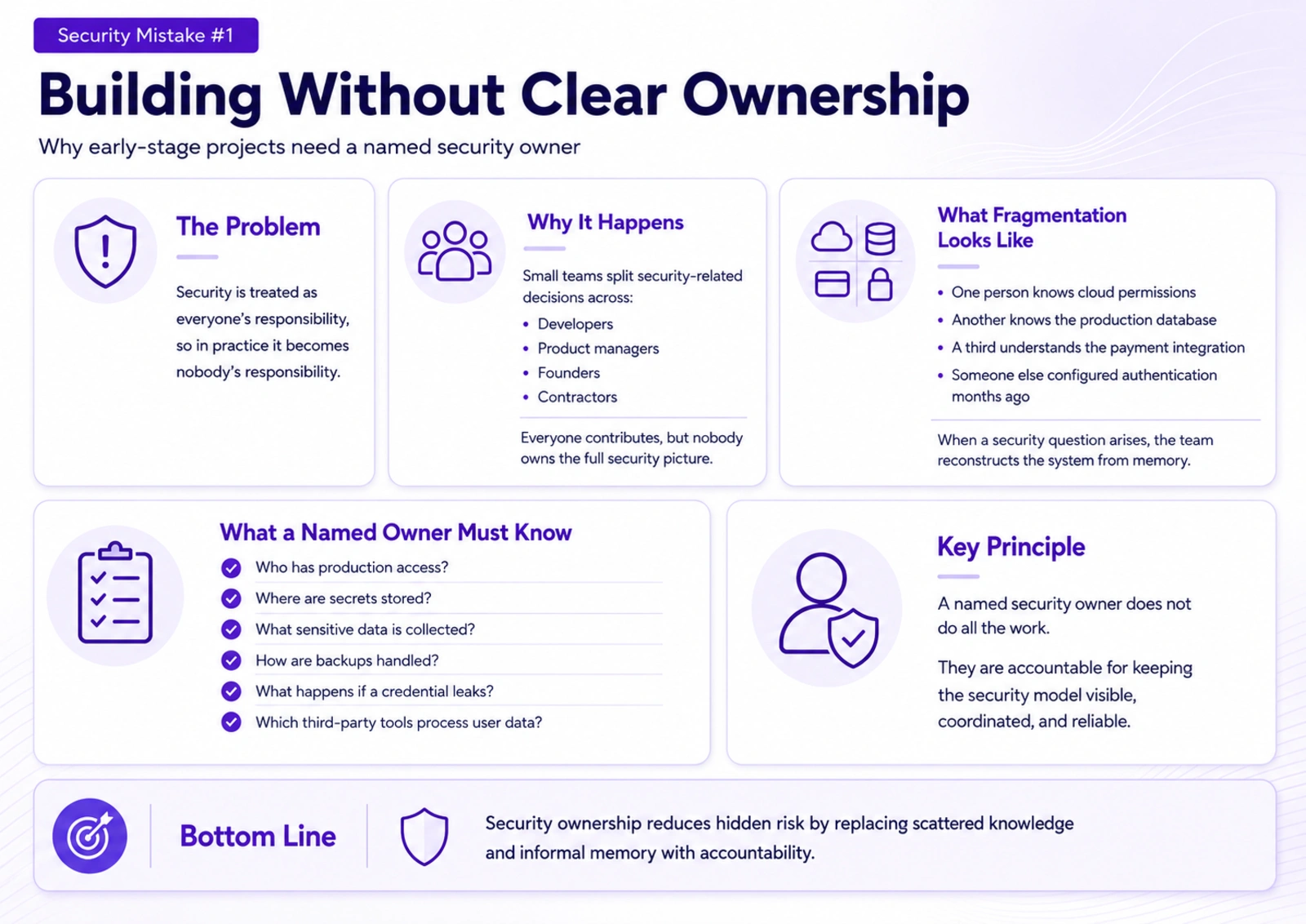
One of the most common early mistakes is assuming security is everyone’s responsibility without making it anyone’s responsibility.
In small teams, this can feel natural. Developers make infrastructure decisions. Product managers define access flows. Founders approve tools. Contractors set up environments. Everyone contributes, but nobody owns the security picture as a whole.
The result is fragmentation.
One person knows how cloud permissions work. Another knows where the production database is hosted. A third person understands the payment integration. Someone else configured the authentication provider months ago. If a security question arises, the team has to reconstruct the system from memory.
That is not a reliable operating model.
Early-stage projects need a named security owner, even if that person is not a security specialist. Their role is not to create bureaucracy. Their role is to make sure basic questions have answers:
Who has production access?
Where are secrets stored?
What sensitive data is collected?
How are backups handled?
What happens if a credential leaks?
Which third-party tools process user data?
This ownership can sit with a technical founder, CTO, lead engineer, or senior developer. The important point is that someone is accountable for keeping the security model visible.
Security ownership does not mean one person does all the work. It means the project does not depend on scattered knowledge and informal memory.
 2. Treating Access as a Convenience Problem
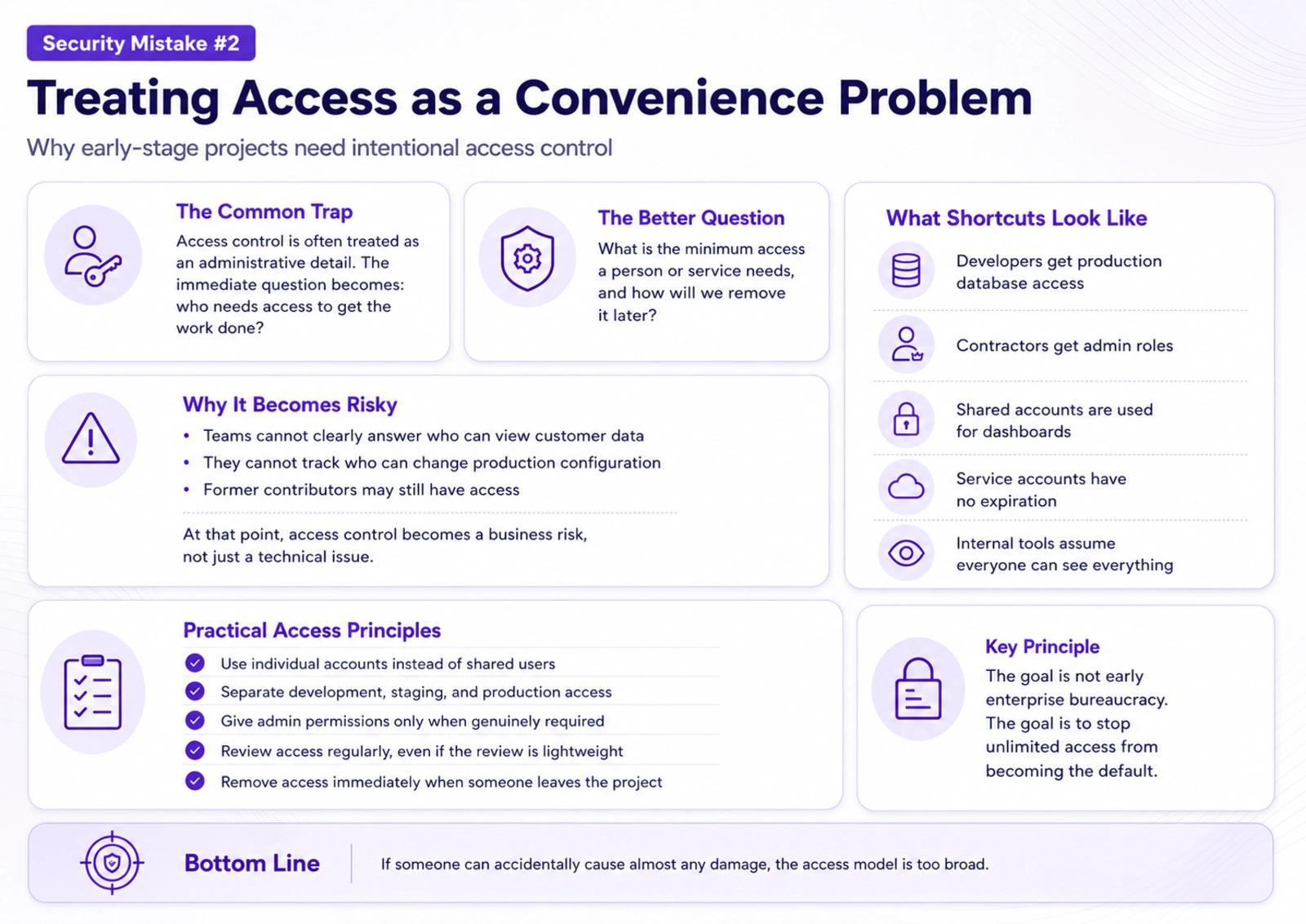
Access control is often treated as an administrative detail in early projects. The immediate question becomes, “Who needs access to get the work done?”
That question is necessary, but incomplete.
The better question is, “What is the minimum access this person or service needs, and how will we remove it later?”
Early projects often grant broad permissions because it is faster. Developers get production database access. Contractors get admin roles. Shared accounts are used for dashboards. Service accounts are created without expiration. Internal tools assume every logged-in user can see everything.
These shortcuts are convenient until the project grows.
The hidden cost appears when the team cannot confidently answer who can view customer data, who can change production configuration, or whether former contributors still have access. At that point, access control becomes a business risk, not just a technical issue.
The practical approach is simple:
Use individual accounts instead of shared users.
Separate development, staging, and production access.
Give admin permissions only when they are genuinely required.
Review access regularly, even if the review is lightweight.
Remove access immediately when someone leaves the project.
The goal is not to create enterprise access governance too early. The goal is to prevent unlimited access from becoming the default.
A useful test is this: if someone accidentally uses their permissions incorrectly, how much damage could they cause?
If the answer is “almost anything,” the access model is too broad.
 3. Hardcoding Secrets and Normalizing Unsafe Shortcuts
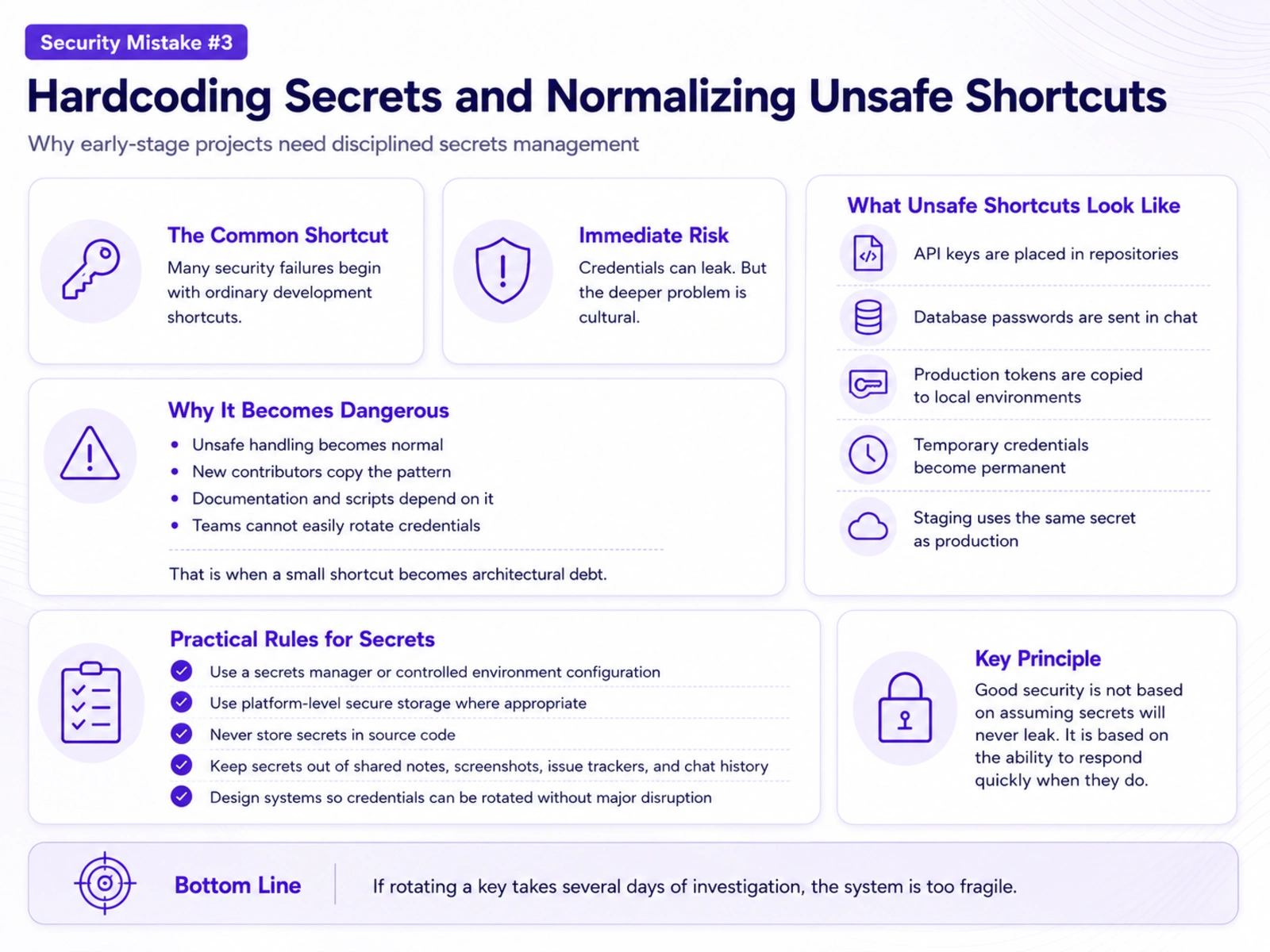
Many security failures begin with ordinary development shortcuts.
An API key is placed in a repository. A database password is sent in a chat message. A production token is copied into a local environment. A temporary credential becomes permanent. A staging system uses the same secret as production.
The immediate risk is obvious: credentials can leak. But the deeper problem is cultural.
When unsafe handling of secrets becomes normal, new contributors copy the pattern. Documentation reflects it. Deployment scripts depend on it. Eventually, the team cannot easily rotate credentials because nobody knows where they are used.
That is when a small shortcut becomes architectural debt.
Early-stage projects should establish basic rules for secrets from the beginning. Secrets should live in a controlled secrets manager, environment configuration, or platform-level secure storage. They should not live in source code, shared notes, screenshots, issue trackers, or chat history.
The project should also be designed so credentials can be rotated without major disruption.
This is a subtle but important point. Good security is not based on the assumption that secrets will never leak. It is based on the ability to respond quickly when they do.
If rotating a key requires several days of investigation, the system is too fragile.
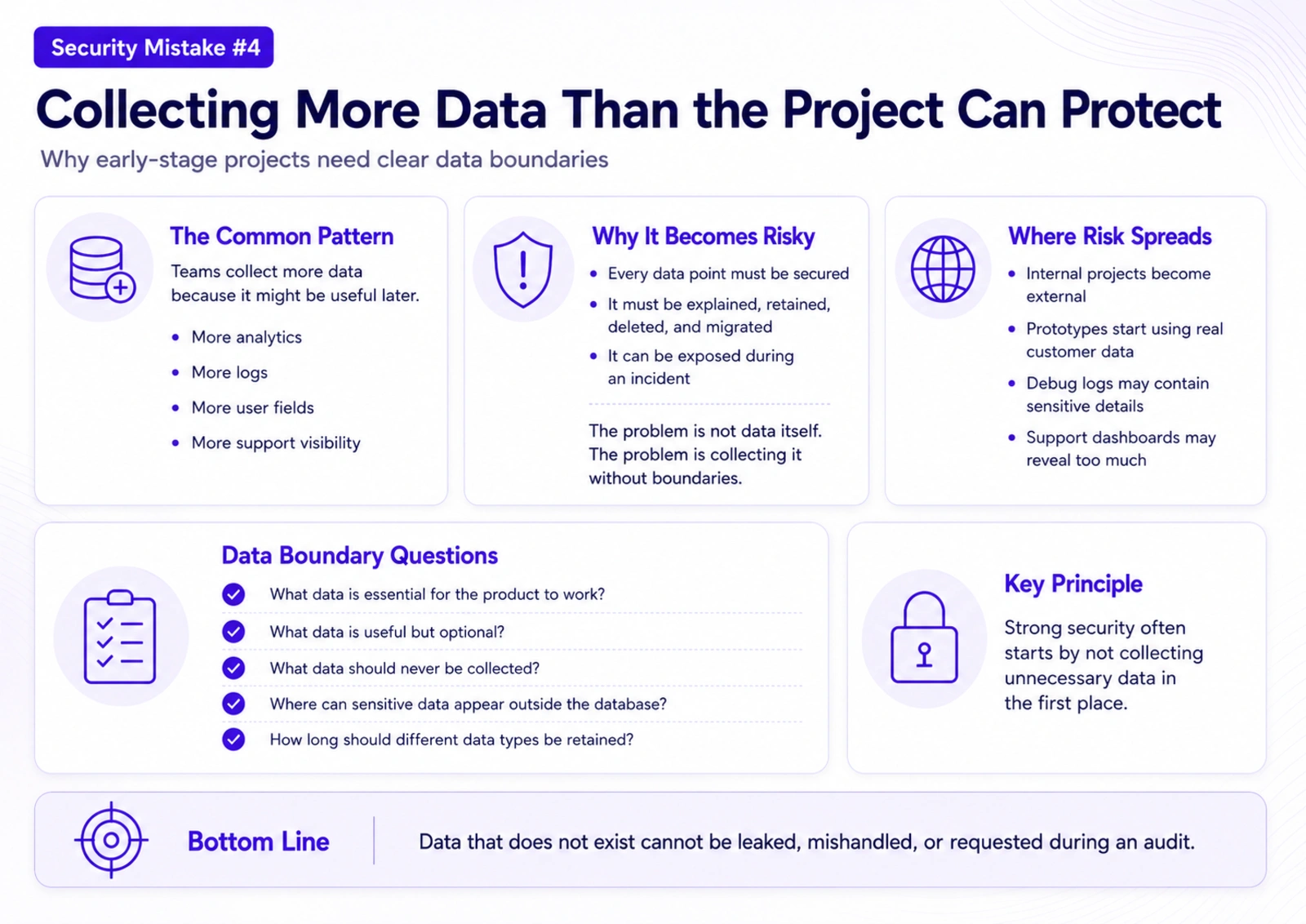
 4. Collecting More Data Than the Project Can Protect
Early-stage teams often collect data because it might be useful later.
More analytics might help product decisions. More logs might help debugging. More user fields might help segmentation. More support visibility might help customer success. On paper, every data point has a possible reason.
But every piece of collected data becomes something the project must secure, explain, retain, delete, migrate, and potentially expose during an incident.
The mistake is not collecting data. The mistake is collecting data without boundaries.
This is especially risky when an internal project becomes external, or when a prototype begins processing real customer information. Data that was acceptable in a test environment may be inappropriate in production. Logs that were useful during debugging may contain sensitive details. Support dashboards may reveal more than support staff need to see.
Early projects should define a simple data boundary model:
What data is essential for the product to work?
What data is useful but optional?
What data should never be collected?
Where can sensitive data appear outside the database?
How long should different data types be retained?
This does not require a large compliance program. It requires discipline.
One of the strongest security decisions a team can make is to avoid collecting unnecessary data in the first place. Data that does not exist cannot be leaked, mishandled, or requested during an audit.
 5. Confusing “Not Public Yet” With “Not at Risk”
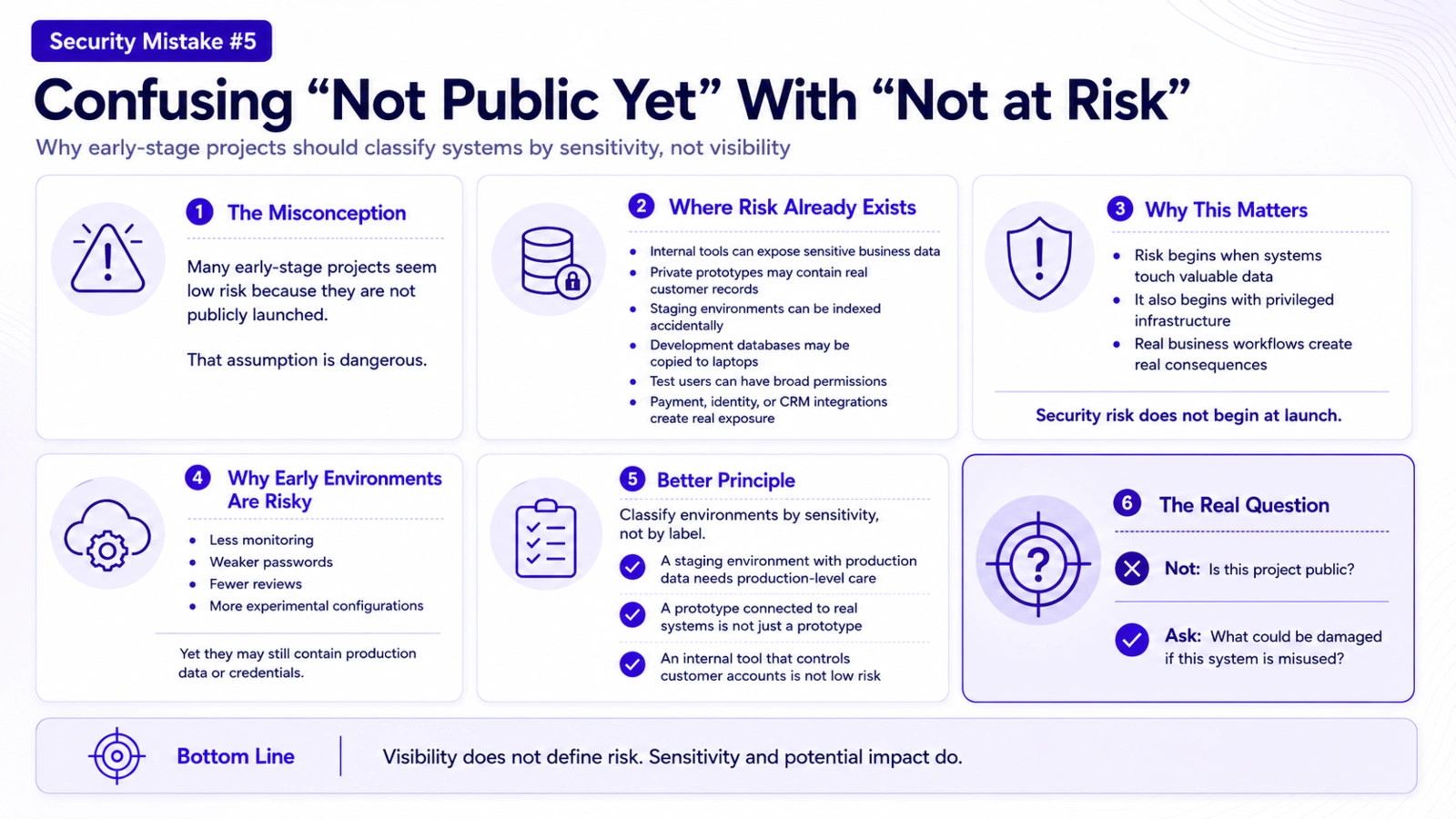
Many early-stage projects are assumed to be low risk because they are not publicly launched.
This is a dangerous misconception.
Internal tools can expose sensitive business data. Private prototypes can contain real customer records. Staging environments can be indexed accidentally. Development databases can be copied to laptops. Test users can have broad permissions. Integrations with payment, identity, or CRM systems can create real exposure even before the product is marketed publicly.
Security risk does not begin at launch. It begins when the system touches valuable data, privileged infrastructure, or real business workflows.
This matters because early environments are often weaker than production. They may have less monitoring, weaker passwords, fewer reviews, and more experimental configurations. Yet they sometimes contain the same data or credentials as production.
A better principle is to classify environments by sensitivity, not by label.
A staging environment with production data should be treated with production-level care. A prototype connected to real systems is not just a prototype. An internal tool that controls customer accounts is not low risk simply because customers never see it.
The question is not, “Is this project public?”
The question is, “What could be damaged if this system is misused?”
 6. Having No Plan for Incidents or Recovery
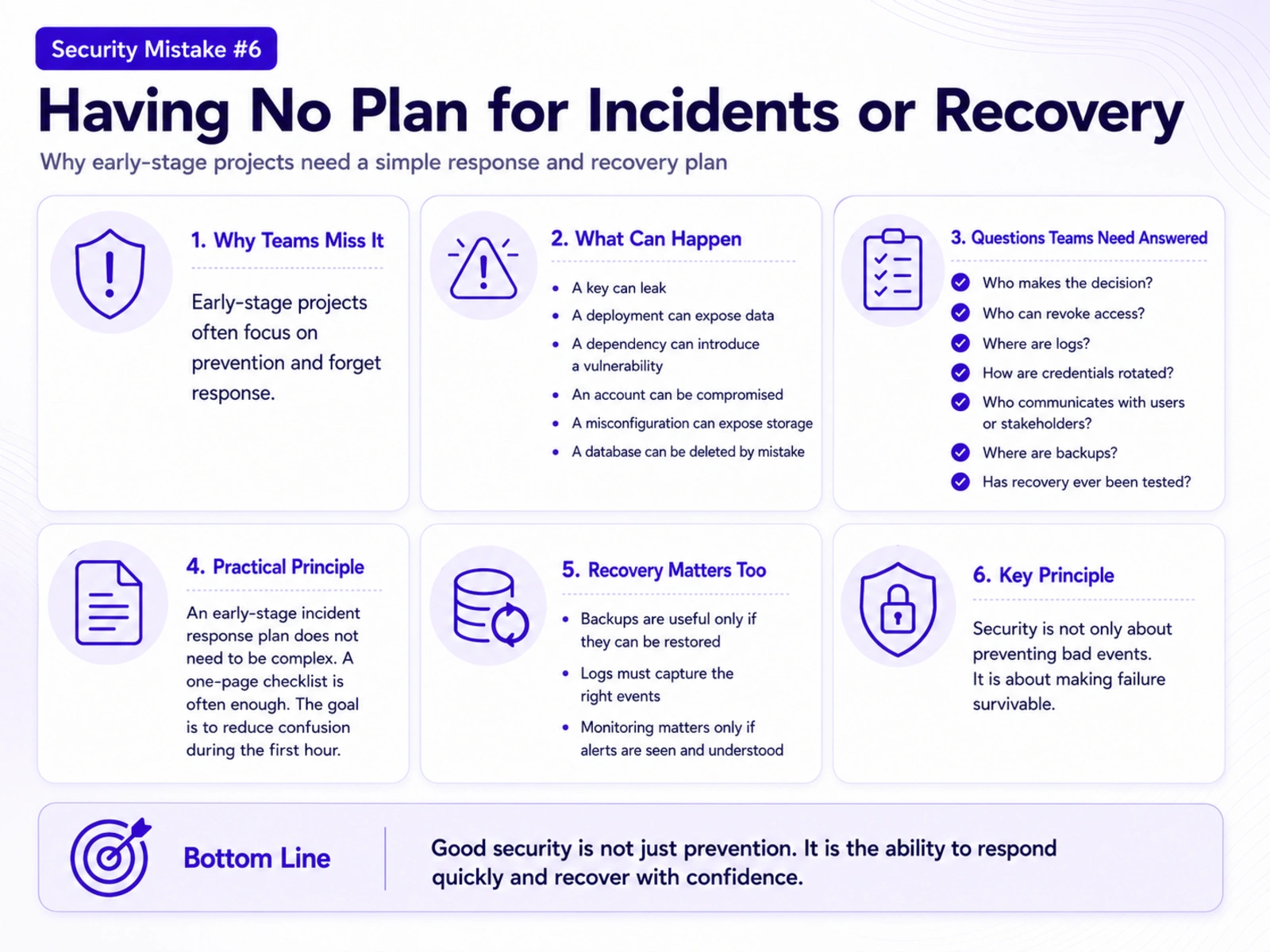
Early-stage projects often focus on prevention and forget response.
But incidents do not wait for maturity. A key can leak. A deployment can expose data. A dependency can introduce a vulnerability. An account can be compromised. A misconfiguration can make a storage bucket public. A database can be deleted by mistake.
Without a basic response plan, the team loses time answering fundamental questions under pressure.
Who makes the decision?
Who can revoke access?
Where are logs?
How are credentials rotated?
Who communicates with users or stakeholders?
Where are backups?
Has recovery ever been tested?
An incident response plan for an early-stage project does not need to be complex. A one-page checklist is often enough. The goal is to reduce confusion during the first hour.
Recovery deserves the same attention. Backups are only useful if they can be restored. Logs are only useful if they capture the right events. Monitoring is only useful if someone sees the alert and understands what it means.
Security is not only about preventing bad events. It is about making failure survivable.
 Key Takeaways
Early-stage projects need security discipline before they need security bureaucracy.
The most important lessons are practical:
Assign clear ownership, even if the owner is not a full-time security specialist.
Avoid shared accounts and broad permissions.
Store secrets properly from the beginning.
Do not collect data without a clear purpose.
Treat staging and internal systems according to their sensitivity, not their name.
Prepare a simple incident and recovery checklist before something goes wrong.
Security should grow with the project, but it should not be postponed until the project becomes important. By then, many decisions are already embedded in the architecture, workflows, and team habits.
The right approach is not to slow early-stage work with excessive process. It is to choose a few security defaults that keep the project flexible, recoverable, and trustworthy.
Conclusion
Security mistakes in early-stage projects are rarely dramatic at first. They look like speed, flexibility, and practical compromise.
That is what makes them difficult to challenge.
The real question is not whether an early project can afford a mature security program. Most cannot, and most do not need one. The better question is whether today’s shortcuts will still make sense when the project has real users, real data, and real business consequences.
Good early security is not about perfection. It is about avoiding fragile foundations.
Every project makes trade-offs. The critical skill is knowing which trade-offs are temporary and which ones are quietly becoming permanent.