
Many founders start measuring engineering performance too late. Others measure it too early, but with the wrong metrics.
The problem is rarely a lack of data. Modern engineering teams can track commits, pull requests, story points, deployments, incidents, velocity, cycle time, uptime, bugs, and dozens of other signals. The real challenge is deciding which numbers actually help a founder understand whether engineering is moving the business forward.
A good engineering KPI framework is not a dashboard full of activity metrics. It is a decision-making system. It should help leadership answer a few critical questions: Are we delivering valuable product changes predictably? Are we building with acceptable quality? Are technical risks increasing or decreasing? Is the engineering team creating leverage, or just staying busy?
For founders, this distinction matters. Engineering is often one of the largest cost centers in an early-stage or growth-stage company. But unlike sales or marketing, its output is harder to measure directly. A weak KPI framework can create false confidence, punish the wrong behavior, and push the team toward short-term activity instead of long-term product capability.
Why Engineering KPIs Are Difficult to Get Right
Engineering work sits between business strategy, product discovery, technical design, execution, operations, and support. That makes simple measurement difficult.
A sales team can often be evaluated through pipeline, conversion rate, revenue, and retention. A support team can be measured through response time, resolution time, and satisfaction. Engineering is more complex because good engineering work often prevents visible problems rather than creating immediately visible outputs.
A team that avoids a major scalability issue may look less “productive” than a team shipping features quickly while silently accumulating technical debt. A senior engineer who spends a week simplifying a fragile system may produce fewer tickets than someone adding new functionality, but the business impact may be higher.
This is why many founders fall into common traps.
They measure individual developer output instead of system performance. They treat story points as productivity. They reward feature volume without tracking quality or maintainability. They focus only on delivery speed and ignore operational stability. Or they ask for “more KPIs” when the real need is clearer engineering priorities.
A strong framework should not try to measure everything. It should measure the few signals that reveal whether engineering is helping the company move faster, learn faster, and reduce risk.
1. Start With Business Alignment, Not Engineering Activity
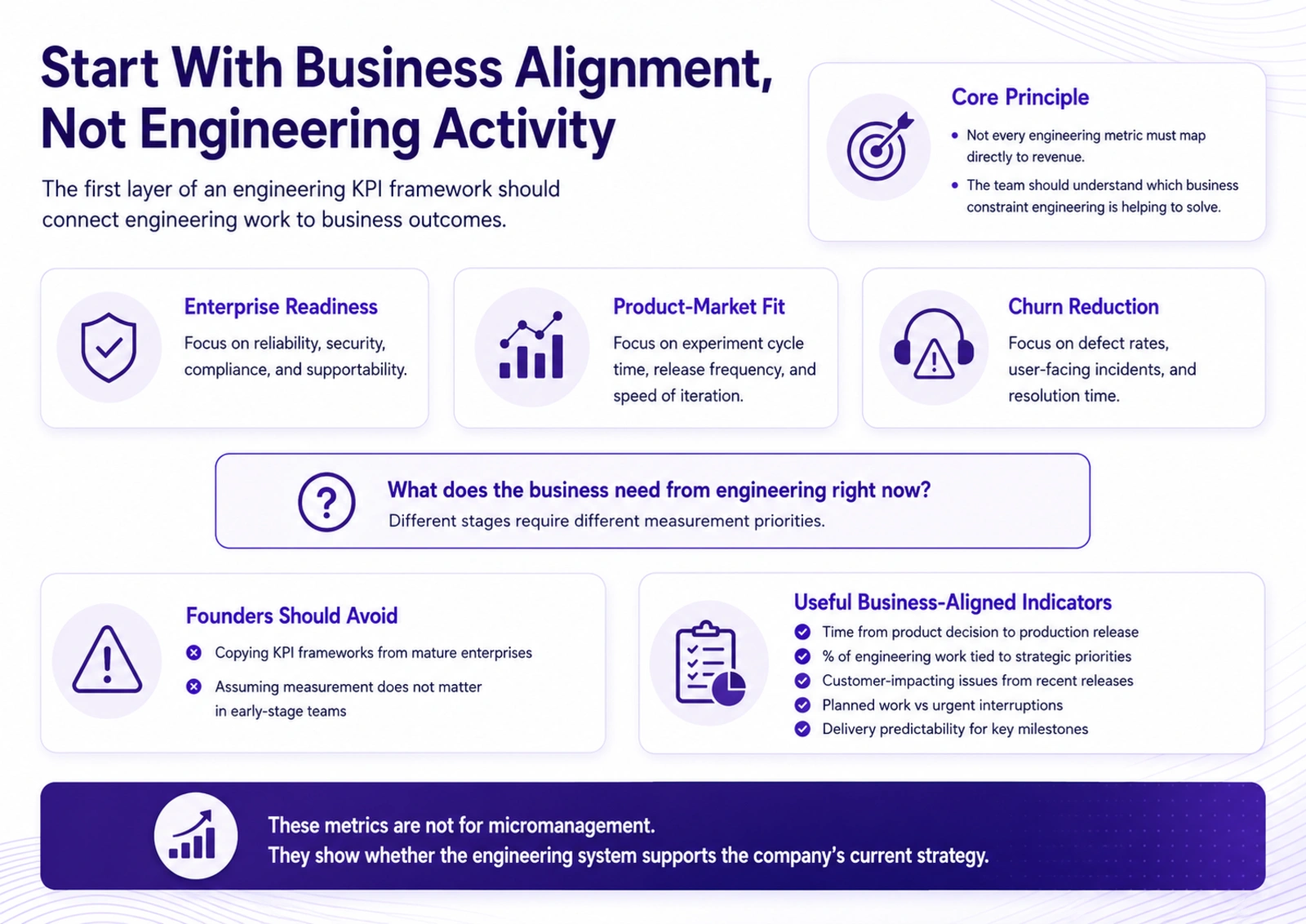
The first layer of an engineering KPI framework should connect engineering work to business outcomes.
This does not mean every engineering metric must directly map to revenue. That would be too simplistic. But it does mean the team should understand which business constraint engineering is currently helping to solve.
For example, a startup preparing for enterprise customers may need engineering KPIs focused on reliability, security, compliance readiness, and supportability. A consumer product still searching for product-market fit may care more about experiment cycle time, release frequency, and speed of iteration. A SaaS company struggling with churn may need to measure defect rates, user-facing incidents, and time to resolve customer-impacting issues.
The key question is: What does the business need from engineering right now?
Different stages require different measurement priorities. Early-stage teams should avoid copying KPI frameworks from mature enterprises. A five-person product team does not need the same metrics as a 300-person engineering organization. At the same time, founders should avoid the opposite mistake: assuming that because the company is early, measurement does not matter.
At a minimum, founders should know whether engineering is improving or slowing down the company’s ability to deliver product value.
Useful business-aligned engineering indicators include:
- Time from product decision to production release
- Percentage of engineering work tied to strategic product priorities
- Number of customer-impacting issues caused by recent releases
- Time spent on planned work versus urgent interruptions
- Delivery predictability for important milestones
These metrics do not exist to micromanage engineers. They exist to show whether the engineering system supports the company’s current strategy.
 2. Measure Flow Before Measuring People
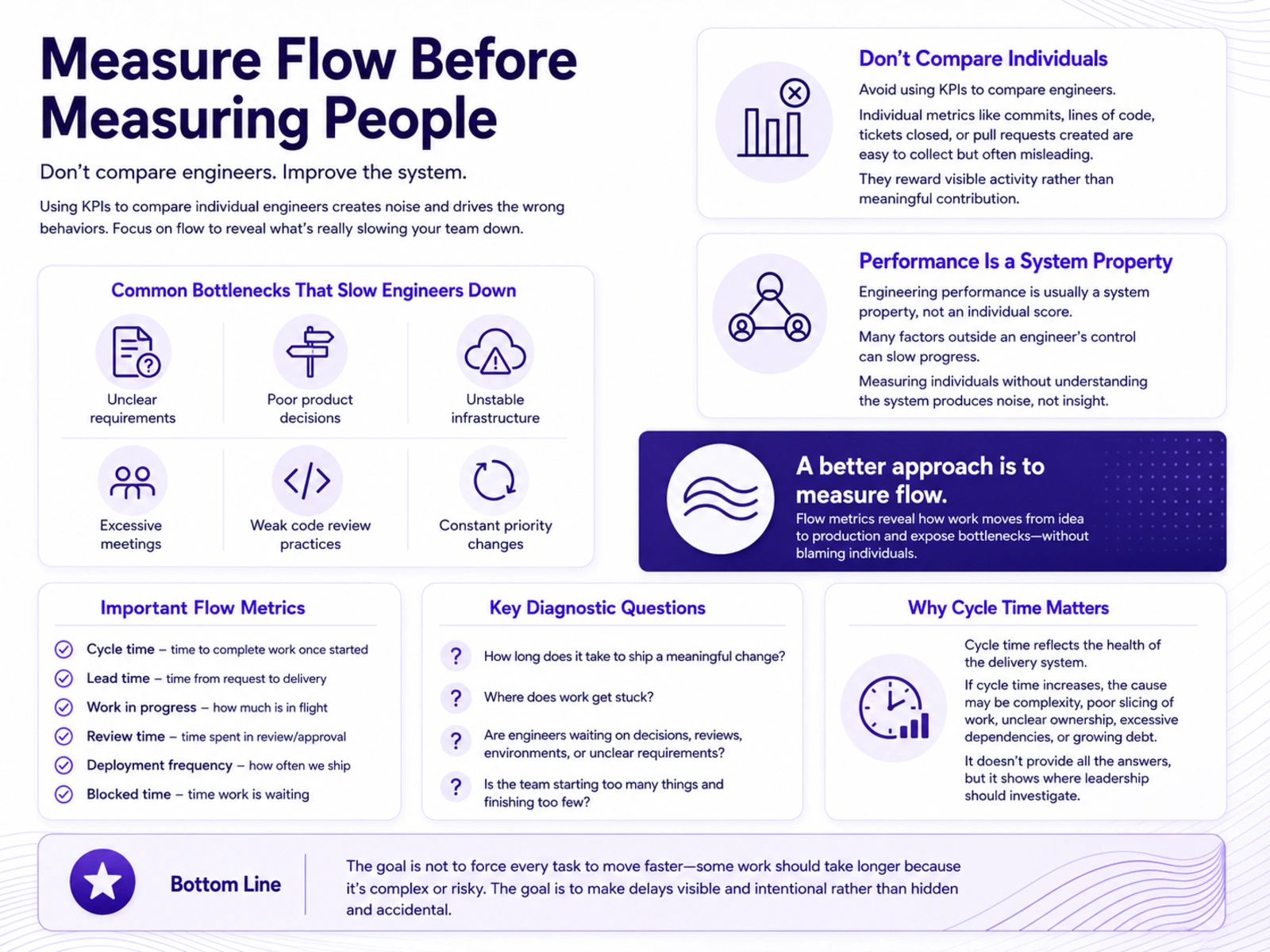
One of the most damaging mistakes founders make is using KPIs to compare individual engineers.
Individual metrics such as number of commits, lines of code, tickets closed, or pull requests created are easy to collect but often misleading. They reward visible activity rather than meaningful contribution. They also create perverse incentives: larger pull requests, shallow fixes, inflated estimates, or avoidance of complex work.
Engineering performance is usually a system property. A strong engineer can be slowed down by unclear requirements, poor product decisions, unstable infrastructure, excessive meetings, weak code review practices, or constant priority changes. Measuring individuals without understanding the system produces noise, not insight.
A better approach is to measure flow.
Flow metrics help founders understand how efficiently work moves from idea to production. They expose bottlenecks without blaming individuals.
Important flow metrics include cycle time, lead time, work in progress, review time, deployment frequency, and blocked time. These signals help answer practical questions:
How long does it take to ship a meaningful change once work begins?
Where does work get stuck?
Are engineers waiting on decisions, reviews, environments, or unclear requirements?
Is the team starting too many things and finishing too few?
Cycle time is especially useful because it reflects the health of the delivery system. If cycle time increases, the cause may be technical complexity, poor slicing of work, unclear ownership, excessive dependencies, or growing debt. The metric does not provide the full answer, but it shows where leadership should investigate.
The goal is not to force every task to move faster. Some work should take longer because it is complex or risky. The goal is to make delays visible and intentional rather than hidden and accidental.
 3. Balance Speed With Quality and Stability
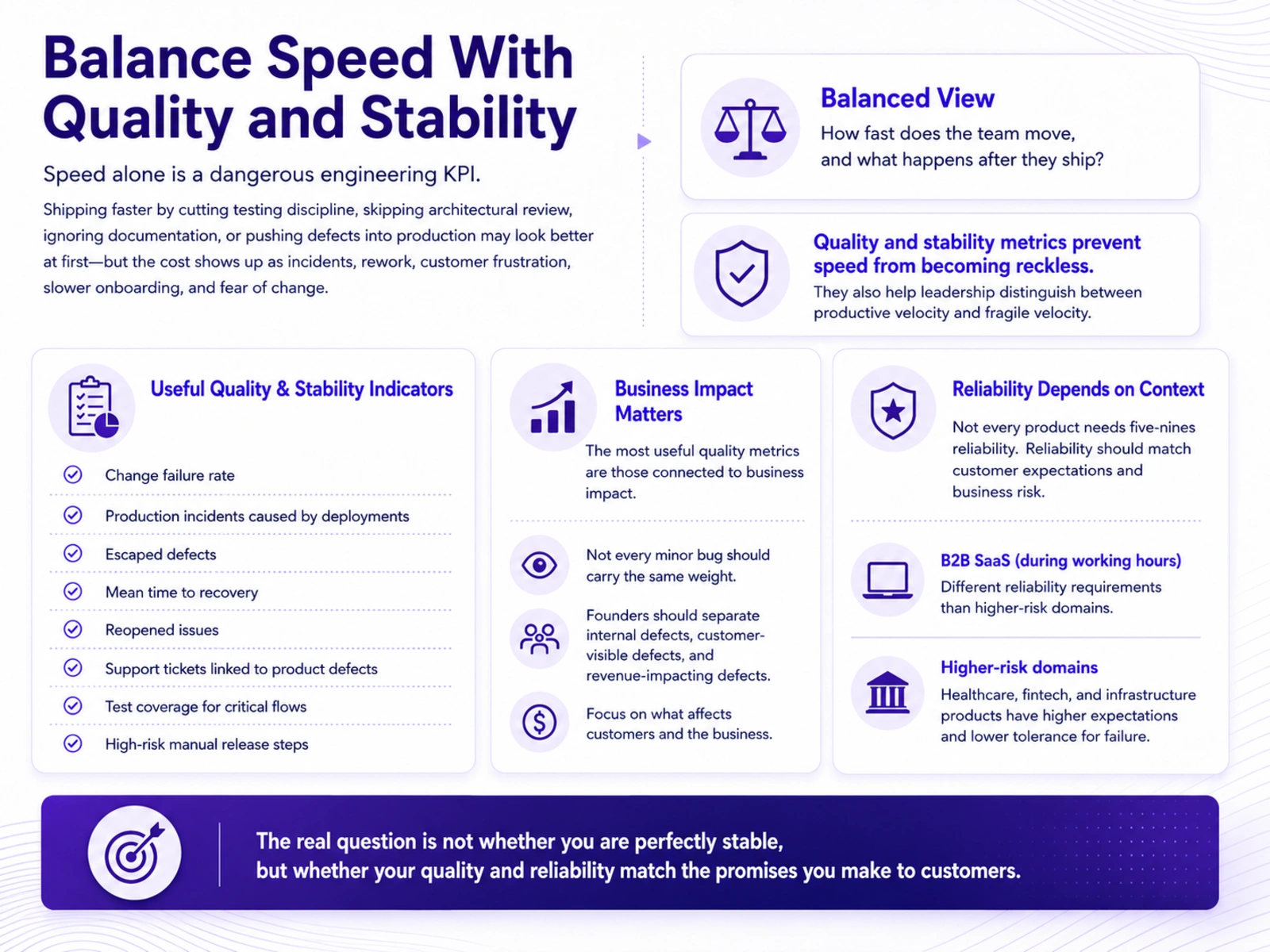
Speed alone is a dangerous engineering KPI.
A team can increase release frequency by reducing testing discipline, skipping architectural review, ignoring documentation, or pushing defects into production. For a few weeks, the dashboard may look better. Eventually, the cost appears as incidents, rework, customer frustration, slower onboarding, and fear of change.
Founders need a balanced view: how fast does the team move, and what happens after they ship?
Quality and stability metrics prevent speed from becoming reckless. They also help leadership distinguish between productive velocity and fragile velocity.
Useful quality and stability indicators include:
- Change failure rate
- Production incidents caused by deployments
- Escaped defects
- Mean time to recovery
- Reopened issues
- Support tickets linked to product defects
- Test coverage for critical flows
- Number of high-risk manual release steps
The most useful quality metrics are those connected to business impact. Counting every minor bug equally can distort priorities. A small UI defect and a billing failure should not carry the same weight. Founders should separate internal defects, customer-visible defects, and revenue-impacting defects.
The same principle applies to uptime. Not every product needs five-nines reliability. But every product needs reliability appropriate to customer expectations and business risk. A B2B SaaS platform used during working hours has different reliability requirements from a healthcare, fintech, or infrastructure product.
The question is not “Are we perfectly stable?” The better question is: Are our reliability and quality levels appropriate for the promises we make to customers?
 4. Track Technical Debt as a Business Risk, Not an Engineering Complaint
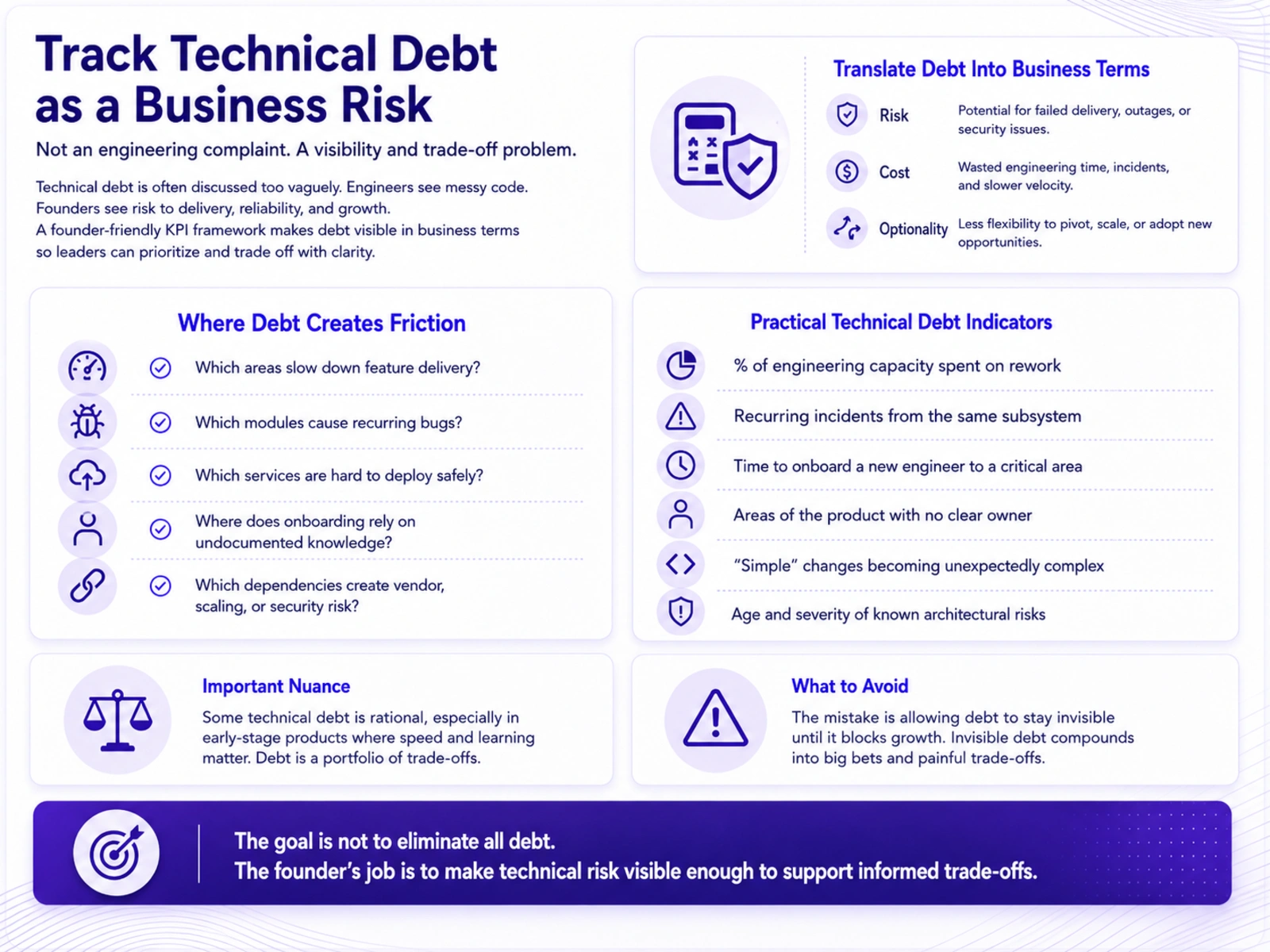
Technical debt is often discussed too vaguely. Engineers say the system is becoming harder to maintain. Founders hear a request to slow down feature delivery. Product teams worry that technical work will consume the roadmap.
The problem is not that technical debt is unimportant. The problem is that it is often described in language that does not support business decisions.
A founder-friendly KPI framework should translate technical debt into risk, cost, and optionality.
Instead of saying “the codebase is messy,” engineering leadership should be able to explain where the debt creates measurable friction:
Which parts of the system slow down feature delivery?
Which modules produce recurring bugs?
Which services are hard to deploy safely?
Where does onboarding require too much undocumented knowledge?
Which dependencies or architectural decisions create vendor, scaling, or security risk?
Technical debt does not need to be eliminated. Some debt is rational, especially in early-stage products where speed and learning matter. The mistake is allowing debt to become invisible until it blocks growth.
Practical technical debt indicators include:
- Percentage of engineering capacity spent on rework
- Number of recurring incidents from the same subsystem
- Time required to onboard a new engineer to a critical area
- Areas of the product with no clear owner
- Frequency of “simple” changes becoming unexpectedly complex
- Age and severity of known architectural risks
A useful framework does not treat technical debt as a moral failure. It treats it as a portfolio of trade-offs. Some debt can be accepted. Some should be scheduled. Some must be addressed before scaling, enterprise sales, compliance work, or major product expansion.
The founder’s role is not to approve every refactoring task. It is to ensure that technical risk is visible enough to make informed trade-offs.
 5. Use KPIs to Improve Conversations, Not Control the Team
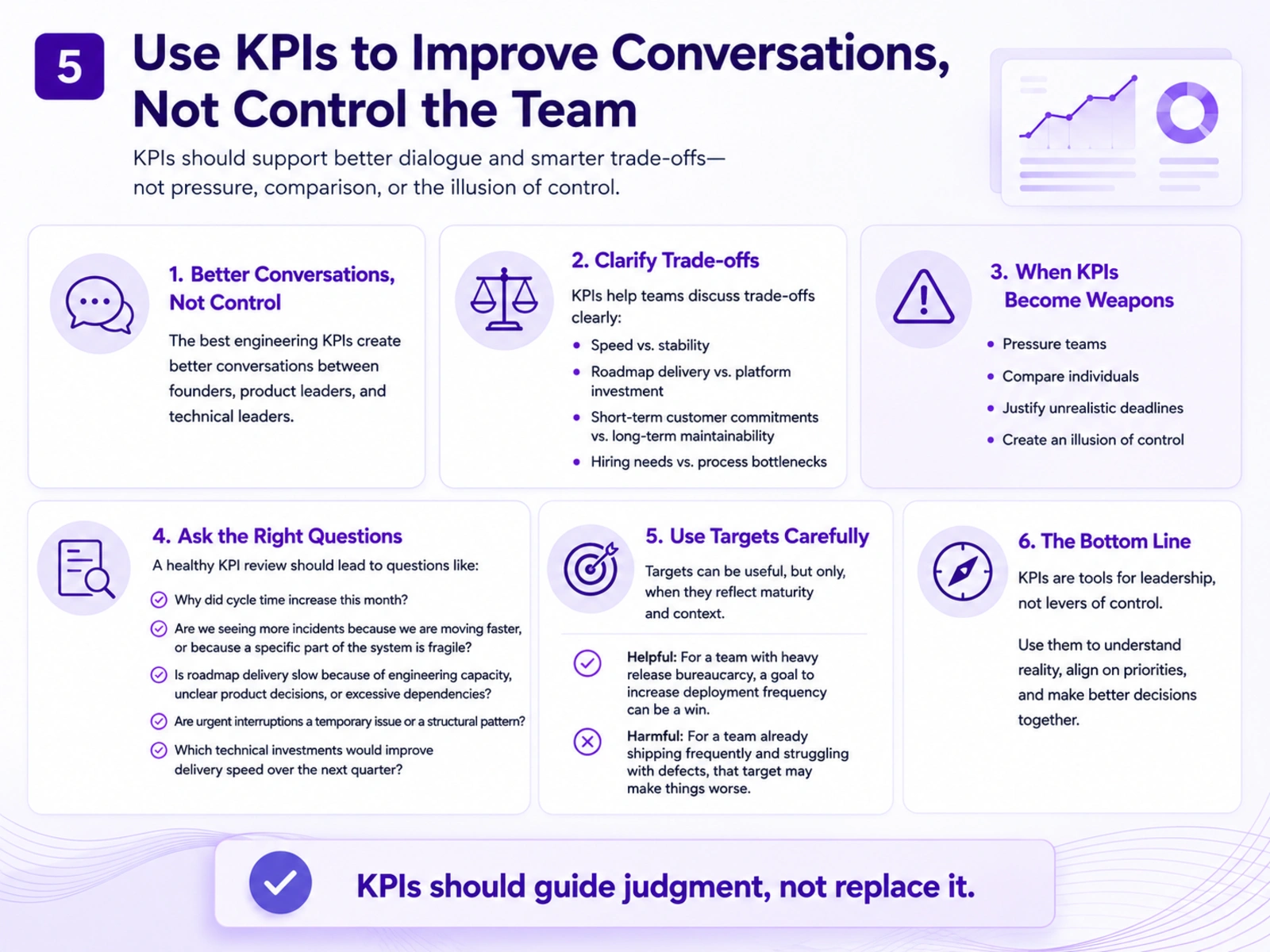
The best engineering KPIs create better conversations between founders, product leaders, and technical leaders.
They should help teams discuss trade-offs clearly: speed versus stability, roadmap delivery versus platform investment, short-term customer commitments versus long-term maintainability, hiring needs versus process bottlenecks.
The worst KPIs become weapons. They are used to pressure teams, compare individuals, justify unrealistic deadlines, or create an illusion of control.
A healthy KPI review should lead to questions such as:
Why did cycle time increase this month?
Are we seeing more incidents because we are moving faster, or because a specific part of the system is fragile?
Is roadmap delivery slow because of engineering capacity, unclear product decisions, or excessive dependencies?
Are urgent interruptions a temporary issue or a structural pattern?
Which technical investments would improve delivery speed over the next quarter?
Founders should also be careful with targets. Targets can be useful, but only when they reflect maturity and context. For example, setting a goal to “double deployment frequency” may be helpful for a team with heavy release bureaucracy. But for a team already shipping frequently and struggling with defects, that target may make things worse.
KPIs should guide judgment, not replace it.
 A Practical Engineering KPI Framework for Founders
A simple framework can be built around five dimensions.
The first is business alignment. This shows whether engineering work supports the company’s current priorities. Useful signals include strategic roadmap progress, customer-impacting delivery, and planned versus unplanned work.
The second is delivery flow. This shows how efficiently work moves through the system. Useful signals include cycle time, lead time, review time, deployment frequency, and work in progress.
The third is quality and reliability. This shows whether speed is sustainable. Useful signals include change failure rate, escaped defects, incidents, mean time to recovery, and customer support issues caused by product defects.
The fourth is technical health. This shows whether the system is becoming easier or harder to change. Useful signals include rework, recurring problem areas, architectural risks, dependency age, and maintainability of critical modules.
The fifth is team sustainability. This shows whether the team can continue performing without burnout or hidden organizational damage. Useful signals include interruption load, meeting load, focus time, on-call burden, attrition risk, and onboarding time.
For most founders, this is enough. The goal is not to create a complex measurement system. The goal is to maintain a balanced view of engineering performance across business value, speed, quality, technical risk, and team health.
Key Takeaways
Engineering KPIs should measure the performance of the engineering system, not just the activity of individual developers.
The best metrics connect engineering execution to business priorities. A startup focused on product discovery, enterprise readiness, or scaling will need different KPI emphasis.
Flow metrics such as cycle time, lead time, review time, and work in progress are often more useful than simplistic productivity measures.
Speed must be balanced with quality and reliability. A team that ships quickly but creates frequent production issues is not truly fast.
Technical debt should be tracked as business risk. Founders need visibility into where debt increases cost, slows delivery, or limits future options.
KPIs should improve leadership conversations. When metrics become tools for pressure or blame, they usually make engineering performance worse.
Conclusion
An engineering KPI framework is not about turning software development into a factory line. It is about making an inherently complex function easier to reason about.
Founders do not need dozens of engineering metrics. They need a small number of well-chosen signals that reveal whether the product organization is becoming faster, safer, and more capable over time.
The most important question is not “How productive are our engineers?” A better question is: “Is our engineering system increasing or reducing the company’s ability to execute?”
That shift changes the conversation from activity to outcomes, from control to clarity, and from short-term output to long-term product capability.