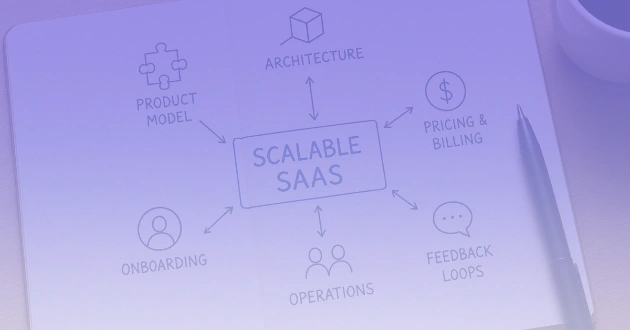

Early-stage products are built under pressure. Teams need to validate ideas quickly, ship usable features, reduce engineering overhead, and avoid spending months building infrastructure that may never matter.
That is why vendors are attractive.
Managed databases, authentication platforms, cloud hosting, analytics tools, payment providers, AI APIs, marketing automation systems, learning platforms, and no-code integrations can help a small team move faster than its internal capacity would normally allow.
But speed has a cost.
The problem is not using vendors. The problem is using vendors without understanding which future decisions you are quietly giving away. Vendor lock-in rarely appears as a dramatic architectural failure. More often, it accumulates through small, reasonable decisions that later make the product expensive to change, hard to scale, or strategically dependent on someone else’s roadmap.
For early-stage companies, the right goal is not to avoid vendors completely. That would be unrealistic and often inefficient. The goal is to use vendors deliberately, with enough architectural and commercial flexibility to avoid being trapped later.
Why Vendor Lock-In Matters Earlier Than Teams Think
Many founders and product leaders assume vendor lock-in is a problem for mature companies. At the earliest stages, the argument often sounds practical: “We just need to move fast. We can replace it later.”
Sometimes that is true.
But “later” is rarely a clean rewrite window. Later usually means the product has paying customers, operational dependencies, reporting requirements, integrations, historical data, internal workflows, and a team that is already overloaded. What looked like a simple vendor choice becomes embedded in the product’s behavior, data model, user experience, and business processes.
The most dangerous lock-in is not always technical. It can be:
- Commercial, where pricing changes directly affect gross margin.
- Operational, where internal teams become dependent on a vendor’s workflows.
- Data-related, where exporting or restructuring information becomes difficult.
- Product-related, where customer-facing functionality depends on proprietary features.
- Strategic, where the vendor’s roadmap starts shaping your own roadmap.
Early-stage teams do not need enterprise-grade procurement processes. But they do need a basic discipline: understand which vendor decisions are reversible, which are expensive to reverse, and which could define the future shape of the product.
1. Separate Acceleration Decisions from Foundation Decisions
Not every vendor choice deserves the same level of scrutiny.
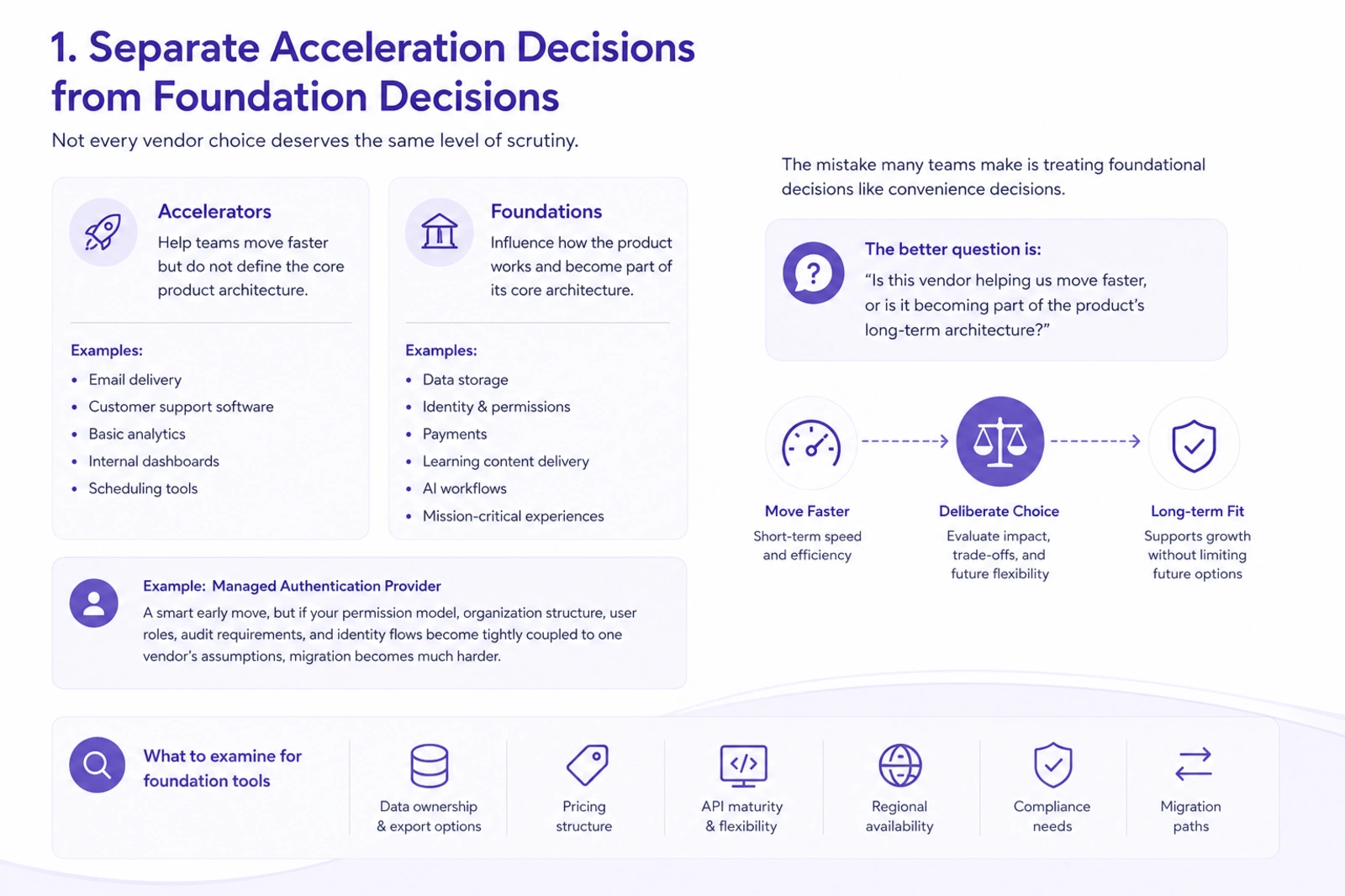
Some tools are accelerators. They help the team move faster but do not define the core product architecture. Examples might include email delivery, customer support software, basic analytics, internal dashboards, or scheduling tools.
Other tools become foundations. They influence how the product stores data, manages identity, handles permissions, processes payments, delivers learning content, runs AI workflows, or serves mission-critical customer experiences.
The mistake many teams make is treating foundational decisions like convenience decisions.
For example, using a managed authentication provider can be a smart early-stage move. But if the product’s permission model, organization structure, user roles, audit requirements, and customer identity flows become deeply coupled to one vendor’s assumptions, migration becomes much harder.
The practical question is not “Should we use this vendor?” The better question is:
“Is this vendor helping us move faster, or is it becoming part of the product’s long-term architecture?”
For accelerator tools, speed may matter more than portability. For foundation tools, teams should slow down enough to examine data ownership, export options, pricing structure, API maturity, regional availability, compliance needs, and migration paths.
This does not mean over-engineering. It means knowing which decisions deserve architectural attention.
 2. Own Your Data Model, Even When You Do Not Own the Infrastructure
Data is where many lock-in problems become expensive.
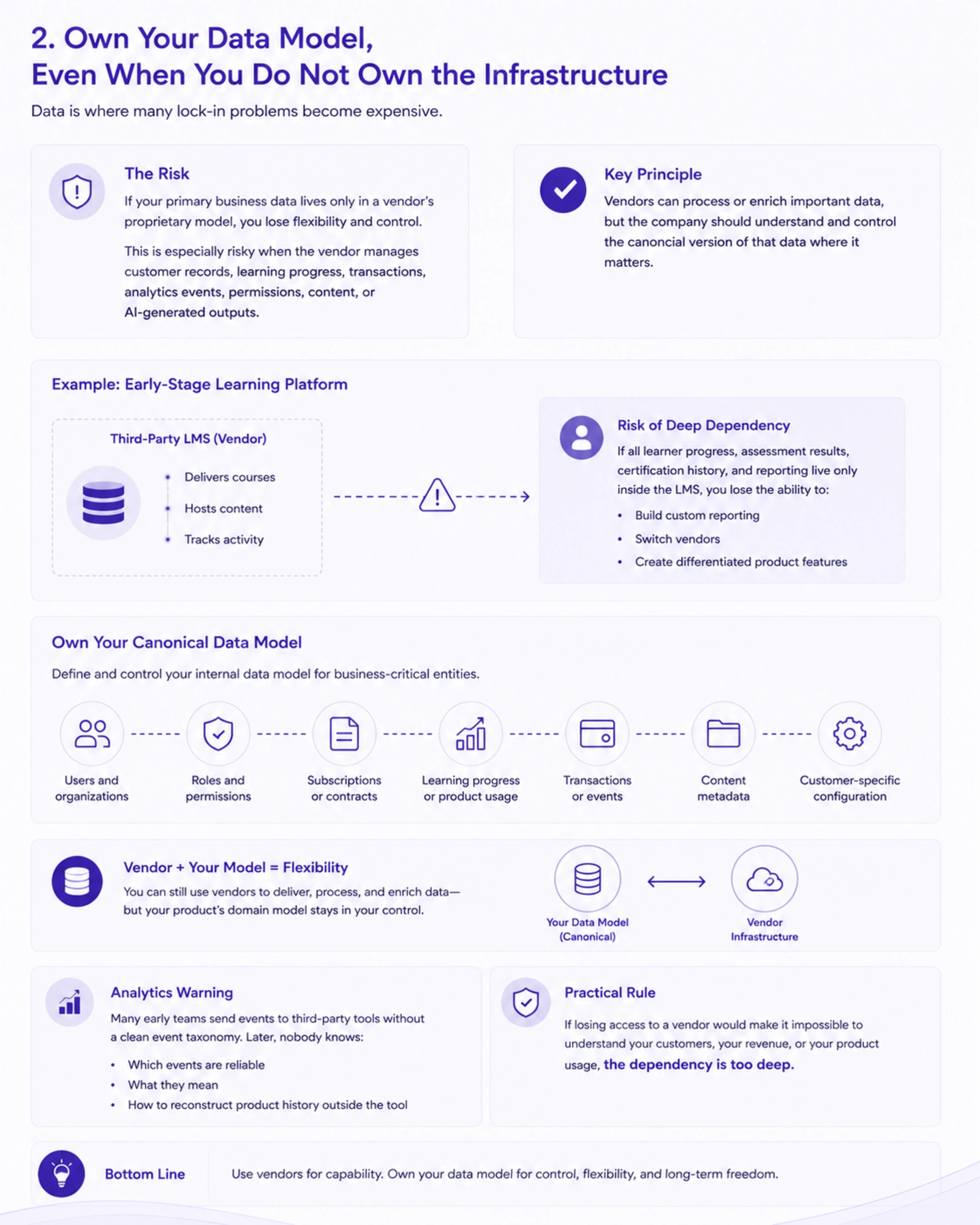
A vendor may offer excellent features, but if the product’s primary business data lives entirely inside that vendor’s proprietary model, the company may lose flexibility. This is especially risky when the vendor manages customer records, learning progress, transaction history, analytics events, permissions, content, or AI-generated outputs.
The key principle is simple: vendors can process or enrich important data, but the company should understand and control the canonical version of that data where it matters.
For example, an early-stage learning platform might use a third-party LMS component to deliver courses. That may be sensible. But if all learner progress, assessment results, certification history, and organizational reporting live only inside that LMS, the company’s ability to build custom reporting, switch vendors, or create differentiated product features becomes limited.
A healthier pattern is to define an internal data model for the business-critical entities:
- Users and organizations.
- Roles and permissions.
- Subscriptions or contracts.
- Learning progress or product usage.
- Transactions or events.
- Content metadata.
- Customer-specific configuration.
The vendor can still be used, but the product should avoid blindly adopting the vendor’s structure as its own domain model.
This is particularly important for analytics. Many early teams send events into a third-party platform without designing a clean event taxonomy. Later, nobody knows which events are reliable, what they mean, or how to reconstruct product history outside the tool.
A practical rule: if losing access to a vendor would make it impossible to understand your customers, your revenue, or your product usage, the dependency is too deep.
 3. Design Abstractions Where Change Is Plausible, Not Everywhere
A common reaction to lock-in risk is to build abstraction layers around everything.
That can be just as harmful.
Early-stage teams do not have the time or engineering capacity to create perfect portability across every service. Trying to make every database, payment provider, cloud function, AI model, and analytics tool easily replaceable can slow the product down and introduce unnecessary complexity.
The better approach is selective abstraction.
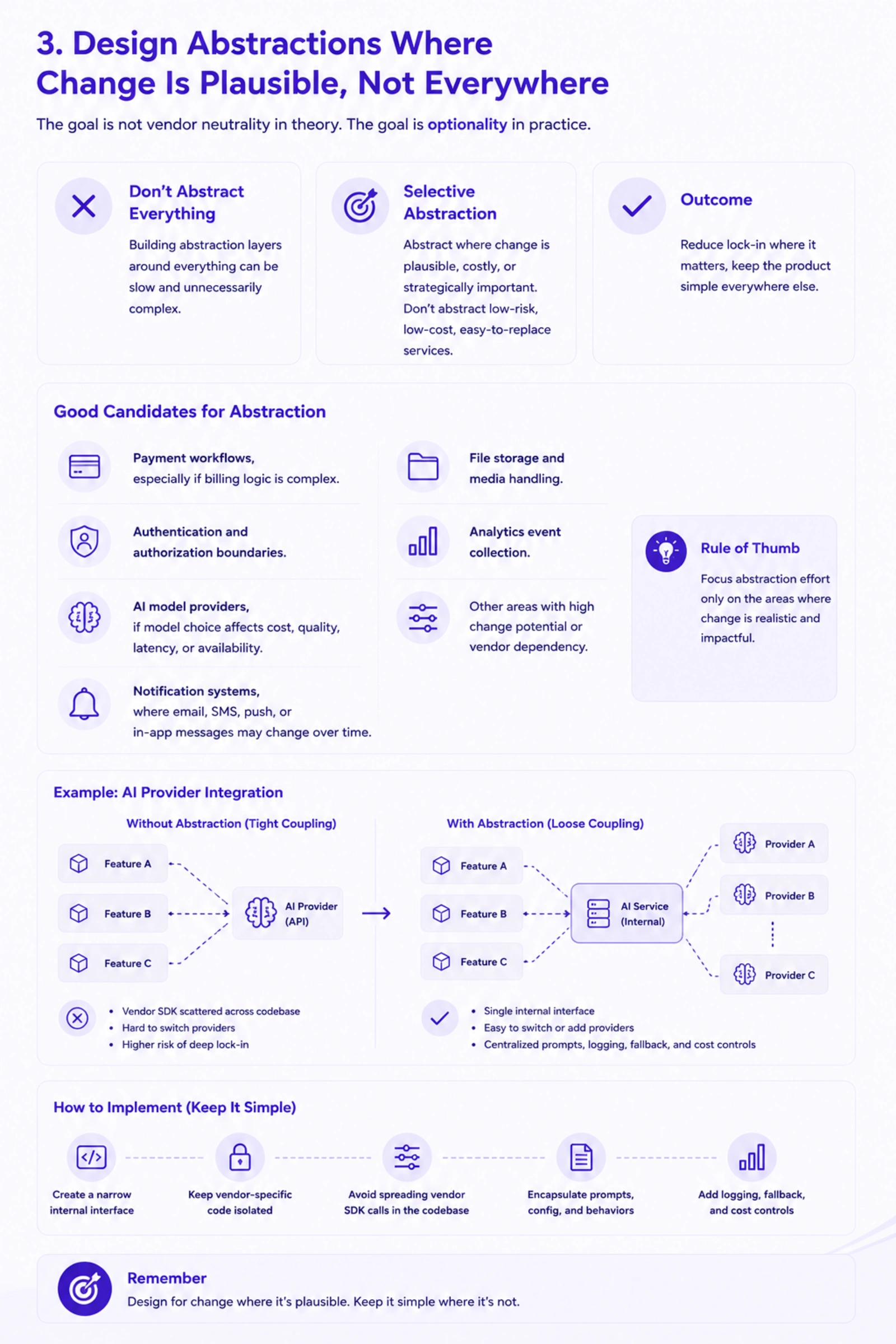
Abstract the areas where change is plausible, costly, or strategically important. Do not abstract areas where the vendor is low-risk, low-cost, and easy to replace.
Good candidates for abstraction include:
Teams should abstract the areas where change is plausible, costly, or strategically important. At the same time, they should avoid abstracting areas where the vendor is low-risk, low-cost, and easy to replace. The point is not to create a theoretically perfect architecture, but to protect flexibility where it is most likely to matter.
Good candidates for abstraction are usually the parts of the product that may affect cost, scalability, user experience, or long-term control. This often includes payment workflows when billing logic is complex, authentication and authorization boundaries, AI model providers where model choice affects cost or quality, notification systems that may need to support email, SMS, push, or in-app messages, file storage and media handling, and analytics event collection.
The abstraction does not need to be elaborate. Sometimes it is enough to create a narrow internal interface, keep vendor-specific code isolated, and avoid spreading vendor SDK calls throughout the codebase.
For example, instead of calling an AI provider directly from multiple product features, teams can route requests through an internal service that handles prompts, model selection, logging, fallback behavior, and cost controls. This does not make switching providers effortless, but it prevents the entire product from being hardwired to one external API.
The goal is not vendor neutrality in theory. The goal is optionality in practice.
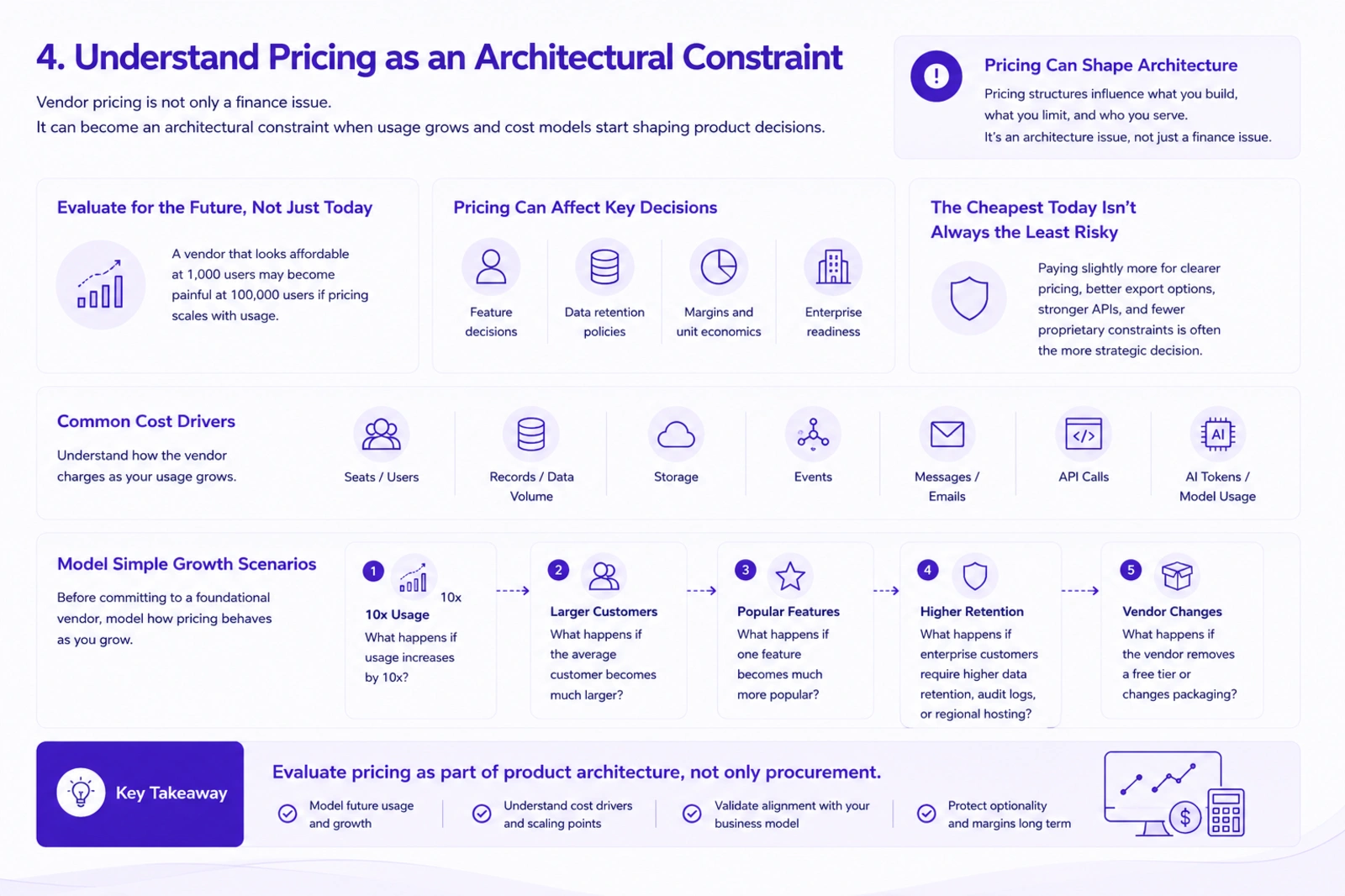
 4. Understand Pricing as an Architectural Constraint
Vendor lock-in is not only about migration difficulty. It is also about unit economics.
A tool can be technically excellent and still become a strategic problem if its pricing model does not align with the product’s growth model.
Early-stage teams often evaluate pricing based on today’s usage. That is understandable, but incomplete. A vendor that costs very little at 1,000 users may become painful at 100,000 users if pricing scales by API calls, seats, records, storage, events, messages, or AI tokens.
This matters because pricing structures can shape product decisions. A founder may avoid adding useful customer features because each interaction triggers expensive vendor usage. A product manager may reduce data retention because storage costs grow unpredictably. A CTO may delay onboarding larger customers because the vendor contract would damage margins.
That is not just a finance issue. It is an architecture issue.
Before adopting a foundational vendor, teams should think beyond the current bill and model how the economics may behave as the product grows. Usage may increase by 10x, the average customer may become larger, one feature may become far more popular than expected, or enterprise customers may require longer data retention, audit logs, regional hosting, and stricter compliance support. The vendor may also remove a free tier, change packaging, or introduce limits that were not relevant at the beginning.
No model will be perfect. But even rough thinking can reveal whether the vendor’s economics support the product’s intended direction.
A subtle but important point: the cheapest vendor today is not always the least risky. Sometimes paying slightly more for clearer pricing, stronger export options, better APIs, and fewer proprietary constraints is the more strategic decision.
 5. Keep Migration Possible Before Migration Is Necessary
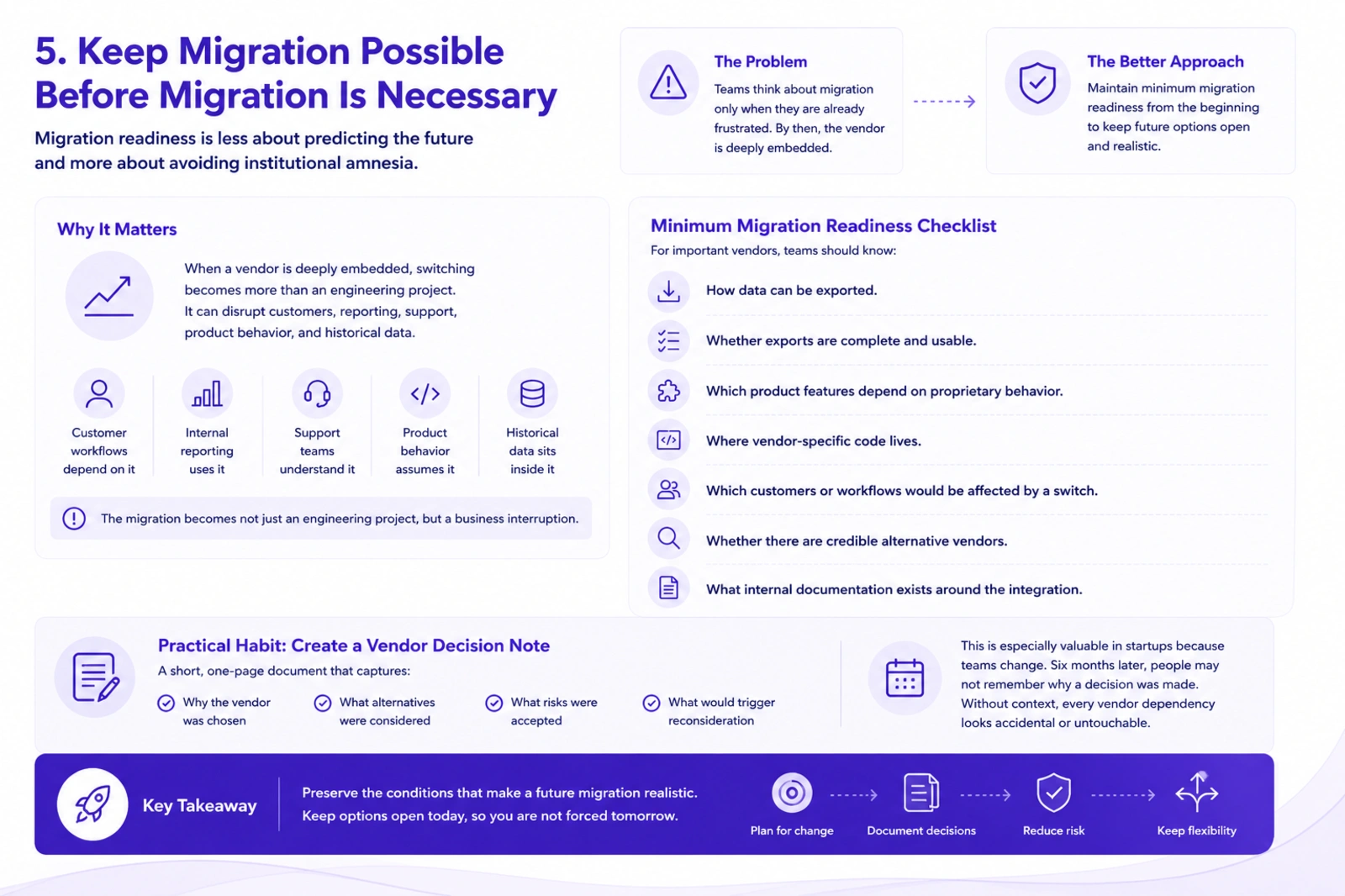
Most teams think about migration only when they are already frustrated.
By then, the vendor is often deeply embedded. Customer workflows depend on it. Internal reporting uses it. Support teams understand it. Product behavior assumes it. Historical data sits inside it. The migration becomes not just an engineering project, but a business interruption.
A better approach is to maintain minimum migration readiness from the beginning.
This does not mean preparing a full replacement plan for every vendor. It means preserving the conditions that would make a future migration realistic.
For important vendors, teams should understand how data can be exported, whether those exports are complete and usable, and which product features depend on proprietary behavior. They should also know where vendor-specific code lives, which customers or workflows would be affected by a switch, whether credible alternative vendors exist, and what internal documentation supports the integration.
One practical habit is to create a short “vendor decision note” when adopting a critical service. It does not need to be bureaucratic. A one-page document can capture why the vendor was chosen, what alternatives were considered, what risks were accepted, and what would trigger reconsideration.
This is especially valuable in startups because teams change. Six months later, people may not remember why a decision was made. Without context, every vendor dependency looks accidental or untouchable.
Migration readiness is less about predicting the future and more about avoiding institutional amnesia.
 Key Takeaways
Vendor lock-in is not caused by using vendors. It is caused by depending on vendors without understanding the dependency.
Early-stage teams should not try to build everything internally. That usually wastes time and reduces focus. But they should clearly distinguish between tools that accelerate execution and tools that become part of the product’s foundation.
The most practical approach is to keep control over business-critical data, isolate vendor-specific logic where future change is plausible, and evaluate pricing against future usage rather than only current cost. Teams should avoid over-abstracting low-risk tools, but they should document important vendor decisions before the reasoning is forgotten.
Migration readiness should be treated as a light discipline, not a major project. The best vendor strategy is not maximum independence. It is informed dependence.
Conclusion
Early-stage products need speed. Vendors provide that speed. But speed becomes dangerous when every shortcut silently reduces future choice.
The strongest teams do not reject vendors out of fear, and they do not adopt them blindly out of convenience. They make conscious trade-offs. They know where they are borrowing capability, where they are accepting risk, and where they need to preserve control.
Vendor lock-in should not be treated as a technical purity debate. It is a strategic design question.
The real question is not whether a product depends on vendors. Every modern product does. The question is whether those dependencies serve the product’s future or quietly limit it.