
Many SaaS founders think about scalability too late. They treat it as a technical concern that becomes relevant after product-market fit, once customers are growing, infrastructure costs are rising, and the engineering team is under pressure.
That is understandable, but risky.
Scalability is not just about whether your servers can handle more users. It is about whether your product, pricing model, onboarding flow, architecture, support model, data structure, and team processes can grow without creating disproportionate complexity.
A SaaS product is scalable when adding the next 100 customers does not require the same amount of manual effort, engineering intervention, or operational improvisation as acquiring the first 100. That does not happen by accident. It requires deliberate design choices early enough to matter, but not so early that the team over-engineers for a future that may never arrive.
The practical challenge for founders is knowing what to check, when to check it, and what trade-offs are worth making.
This article offers a product scalability checklist for SaaS founders who want to grow without turning their product into a fragile collection of workarounds.
Why Product Scalability Matters Earlier Than Most Founders Expect
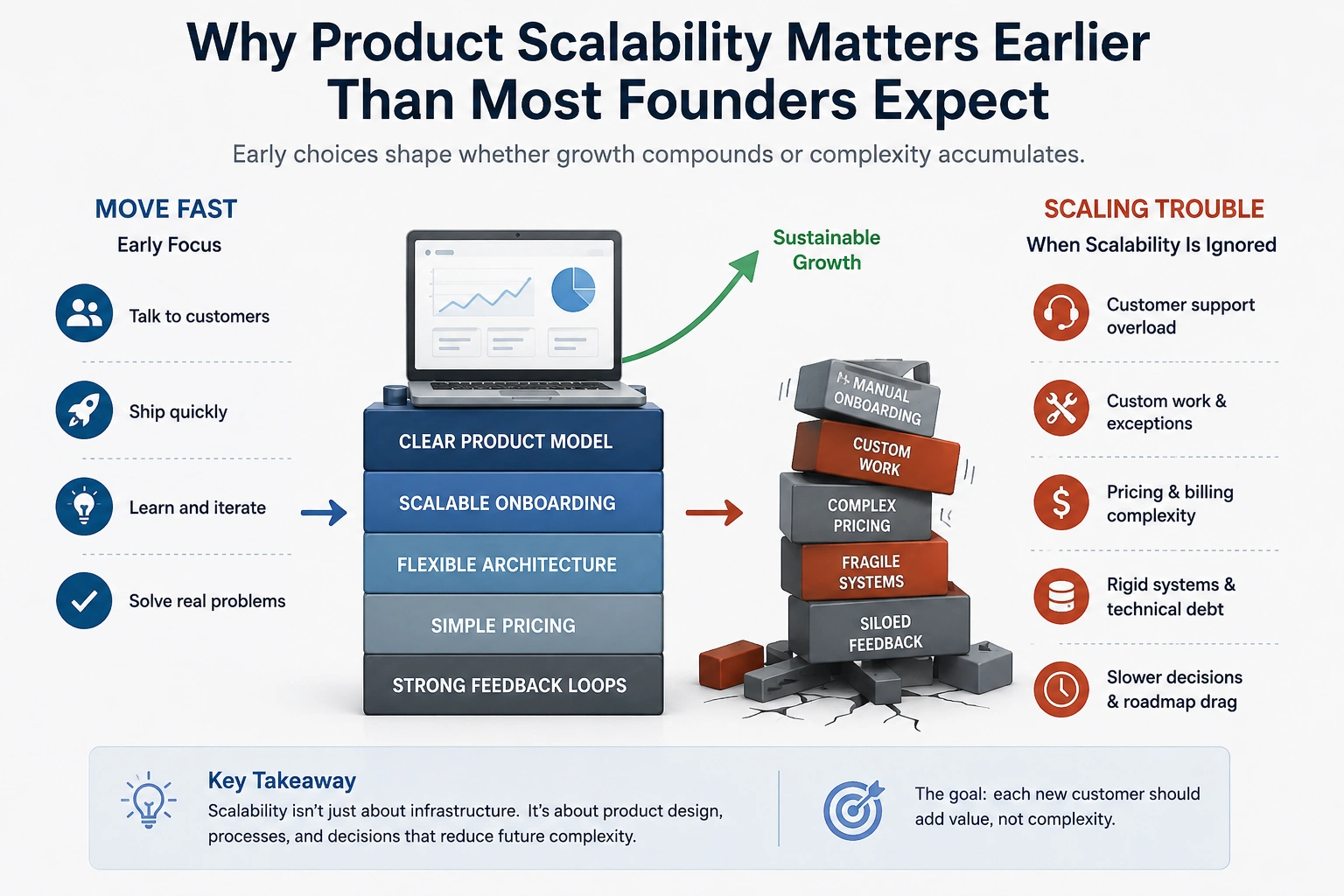
In the early stages of a SaaS company, speed is usually more valuable than elegance. Founders should talk to customers, ship quickly, and avoid building systems for hypothetical scale. But “move fast” is often misinterpreted as “ignore structural consequences.”
That is where problems begin.
A product can appear healthy while quietly accumulating scalability debt. The sales team closes slightly different customer requests. Product managers accept too many exceptions. Engineers patch edge cases instead of clarifying the model. Customer success handles onboarding manually. Reporting is built one customer at a time. Pricing depends on custom logic that the product does not support cleanly.
At low volume, this may feel manageable. At higher volume, it becomes operational drag.
The most common misconception is that scalability is a future infrastructure project. In reality, scalability issues often appear first in customer support, implementation timelines, permissions models, billing complexity, onboarding friction, and internal decision-making. The database may still be fine while the business model is already under strain.
Founders should therefore treat scalability as a product discipline, not merely an engineering milestone.
 1. Validate Whether the Product Model Can Support More Customer Variety
The first scalability question is not technical. It is conceptual:
Can your product serve more customers without becoming a different product for each one?
Early SaaS companies often win customers by being flexible. That flexibility is useful for learning, but dangerous when every deal introduces a new workflow, role type, permission exception, data field, integration requirement, or reporting format.
A scalable product has a clear underlying model. It can accommodate variation, but not unlimited variation.
For example, a B2B SaaS platform serving mid-market companies may support multiple user roles, approval flows, and data segmentation rules. That can be scalable if those variations are built around a coherent permission system. It becomes unscalable if every customer requires hardcoded role logic or manual configuration by engineering.
Founders should examine whether customer differences are being absorbed through product design or through internal labor.
Useful questions include:
- Are customer-specific features becoming part of the core product, or remaining hidden exceptions?
- Can non-technical teams configure the product without engineering support?
- Are customers asking for fundamentally different workflows, or simply different settings within the same workflow?
- Does the product have a clear “default path,” or is every customer implementation bespoke?
The trade-off is important. Over-standardizing too early can prevent learning. But allowing infinite variation can destroy focus. The goal is not to eliminate flexibility. It is to convert repeated flexibility into configurable product patterns.
A strong sign of product scalability is when customer success can support more customer types without needing engineering to interpret each account.
2. Check Whether Onboarding Scales Without Founder or Engineering Intervention
Onboarding is one of the clearest indicators of SaaS scalability.
Many early products rely on heroic onboarding. Founders personally guide customers. Engineers import data manually. Customer success explains concepts that the interface does not make obvious. This can be acceptable in the discovery phase, especially for complex B2B products. But it should not remain invisible.
The danger is mistaking high-touch onboarding for customer success when it is actually product incompleteness.
A scalable onboarding model does not always mean fully self-serve. Enterprise SaaS may always require some implementation support. The key question is whether onboarding effort grows linearly with every new customer, or whether the process becomes repeatable, measurable, and increasingly product-led.
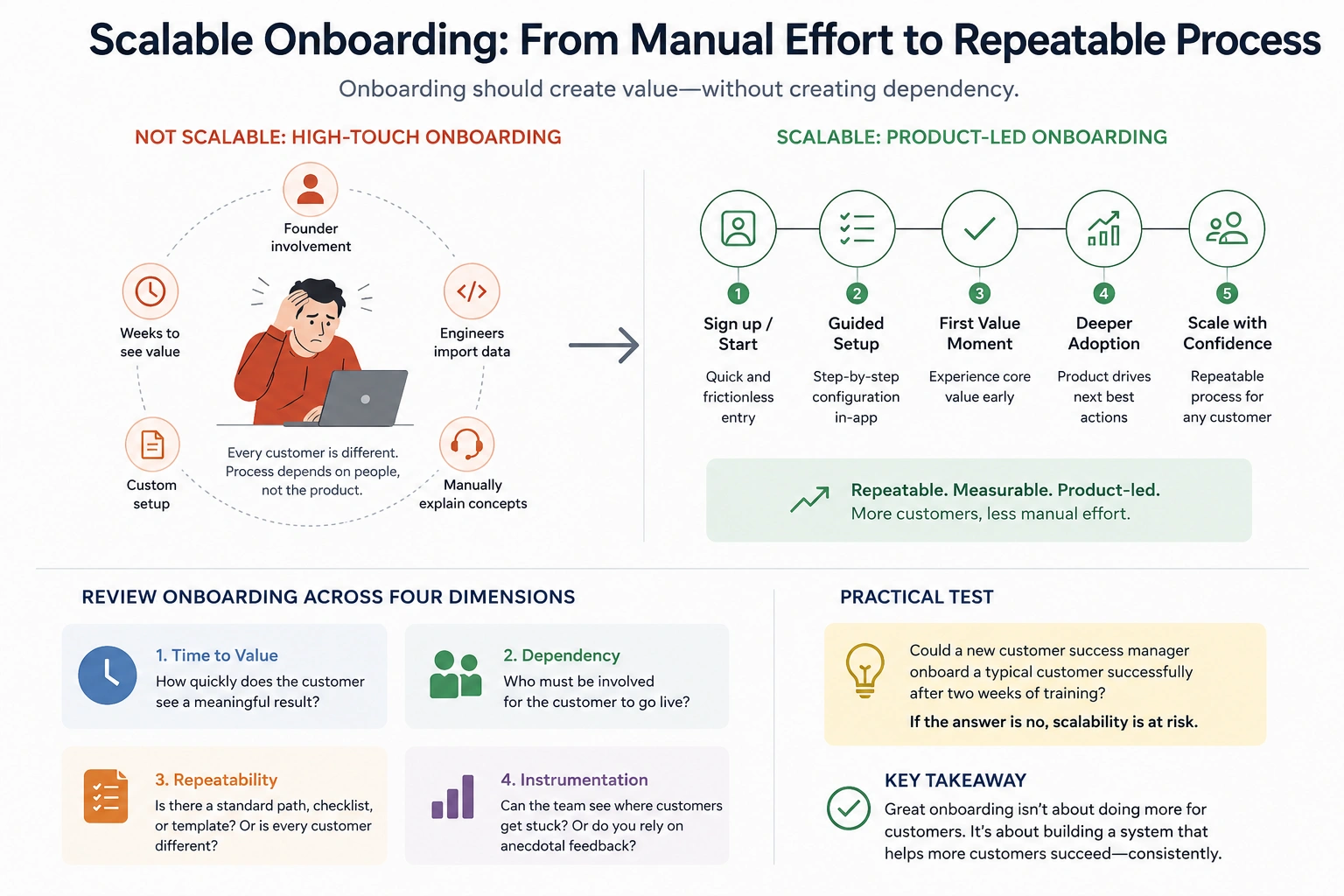
Founders should review onboarding across four dimensions.
First, time to value. How quickly does a new customer experience a meaningful result? If value depends on weeks of configuration, custom training, or internal follow-up, growth may slow as volume increases.
Second, dependency. Who must be involved for a customer to go live? If founders, senior engineers, or product leaders are regularly needed, the onboarding process is not scalable.
Third, repeatability. Is there a standard implementation path, checklist, template, or workflow? Or does each customer require new thinking?
Fourth, instrumentation. Can the team see where customers get stuck, or does it depend on anecdotal feedback?
A practical test is to ask: could a new customer success manager onboard a typical customer successfully after two weeks of training? If the answer is no, the product may still be too dependent on undocumented knowledge.
Founders do not need to automate everything immediately. But they should identify which onboarding steps are educational, which are operational, and which exist only because the product experience is unclear.
The last category is where scalability breaks.
 3. Assess Architecture Through the Lens of Product Change, Not Just Traffic
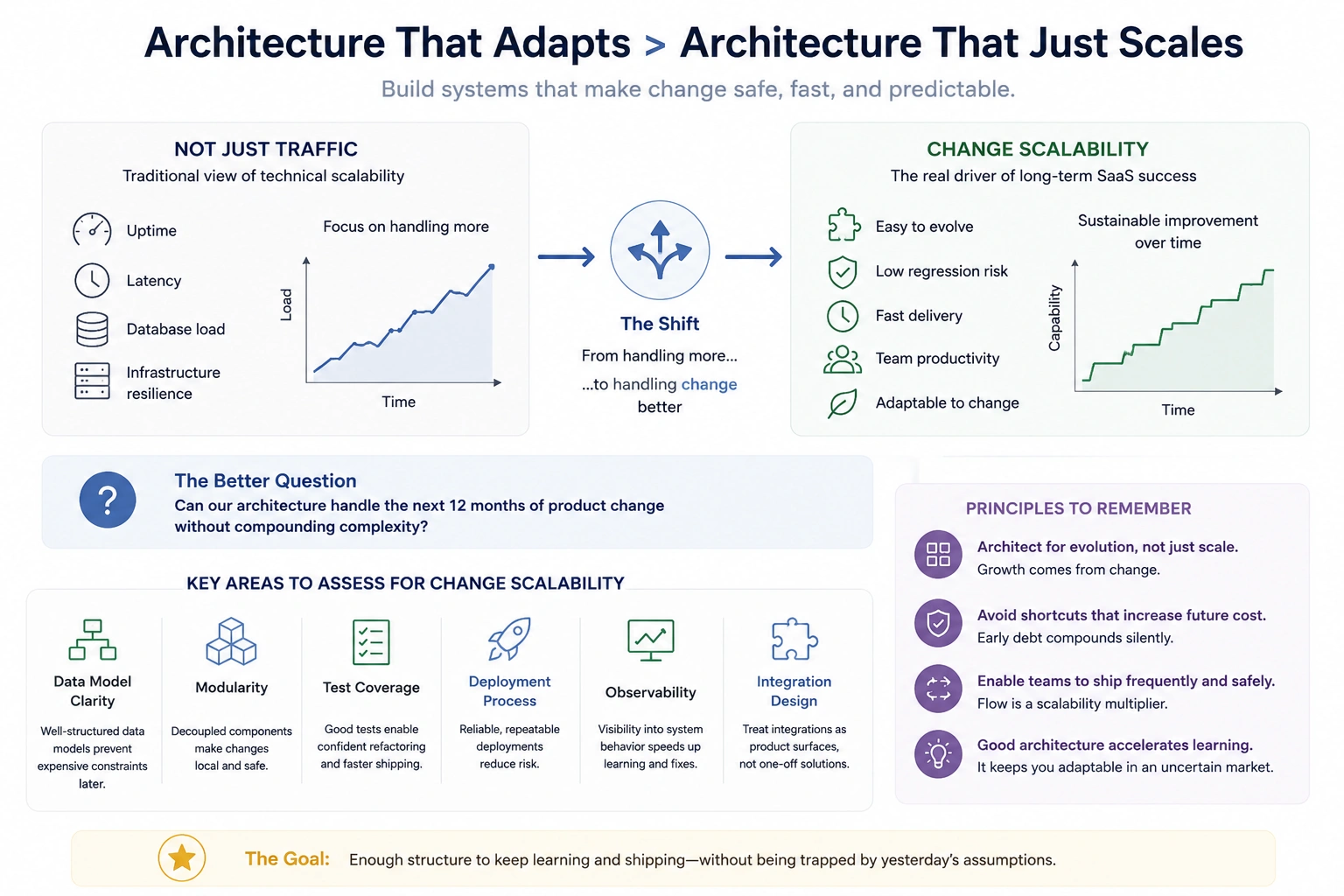
Technical scalability is often reduced to performance: uptime, latency, database load, and infrastructure resilience. These matter, but for many SaaS companies, the bigger issue is change scalability.
Can the team keep improving the product without every change creating regression risk, migration pain, or architectural confusion?
A SaaS product that scales must support both usage growth and product evolution. Founders should be careful not to measure engineering health only by whether the system is currently stable. A system can be stable because the team is afraid to touch it.
Key areas to examine include data model clarity, modularity, test coverage, deployment process, observability, and integration design.
The data model is especially important. Early shortcuts in data architecture can become expensive when customers need analytics, permissions, audit trails, billing accuracy, or integrations. For example, if the product does not clearly distinguish between users, accounts, teams, workspaces, and billing entities, the company may struggle later with enterprise features.
Similarly, integrations should be treated as long-term product surfaces, not one-off customer favors. A hastily built integration may close a deal, but ten such integrations can create a maintenance burden that slows the entire roadmap.
The right question is not, “Can our architecture handle a million users?” For most founders, that question is premature. A better question is:
Can our architecture handle the next 12 months of product change without compounding complexity?
This reframes scalability as adaptability. The product does not need a perfect future-proof architecture. It needs enough structure that the team can keep learning and shipping without being trapped by yesterday’s assumptions.
 4. Review Pricing, Packaging, and Billing for Operational Scalability
Pricing is often left out of product scalability discussions, but it can become one of the most painful sources of complexity.
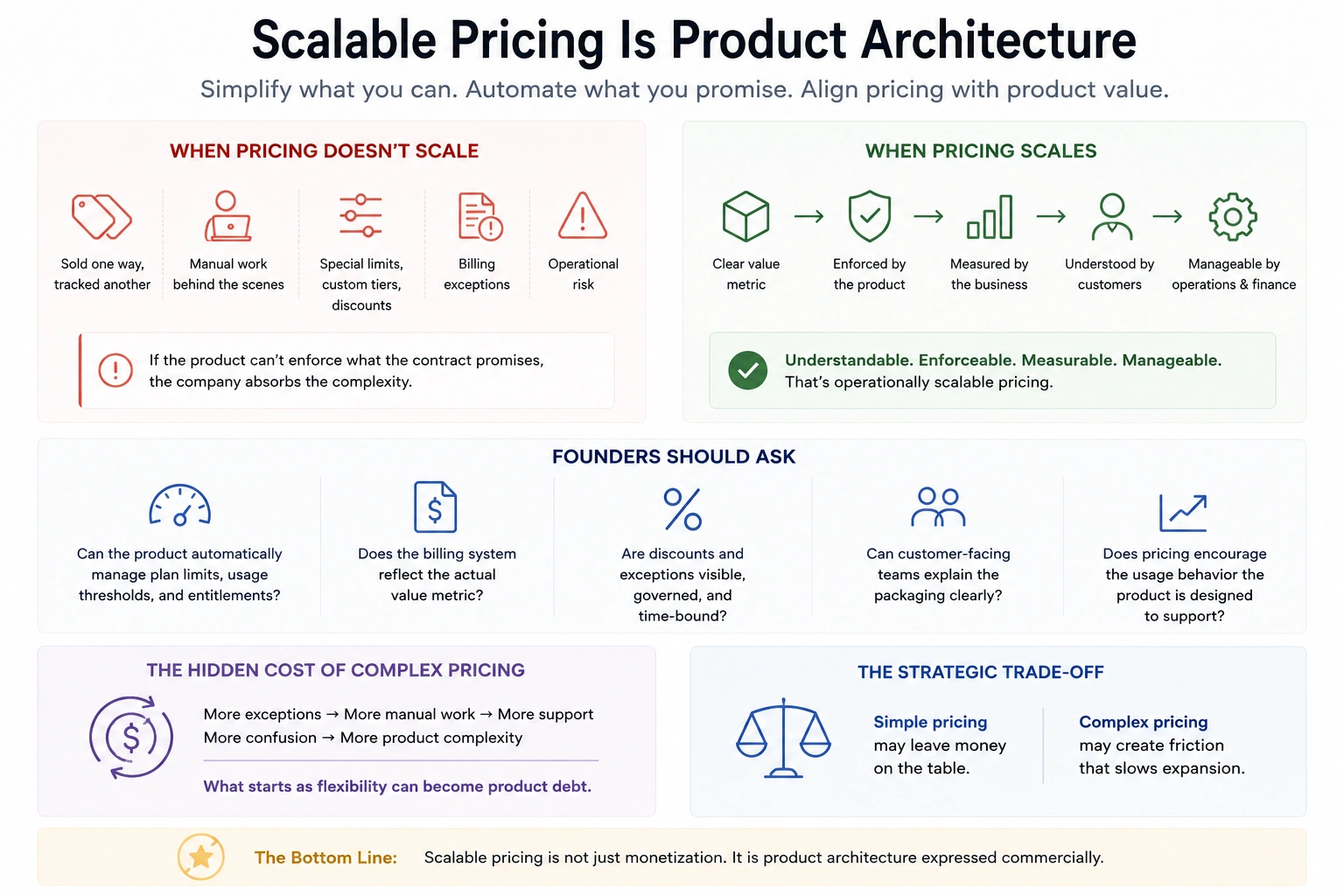
A pricing model is scalable when it is understandable to customers, enforceable by the product, measurable by the business, and manageable by finance and operations.
Problems arise when pricing is sold one way, tracked another way, and implemented manually behind the scenes. This often happens in founder-led sales. To close early deals, companies offer special limits, custom tiers, unusual discounts, account-specific entitlements, or manual billing exceptions.
Some flexibility is normal. But if the product cannot enforce what the contract promises, the company is creating operational risk.
Founders should ask:
- Can the product automatically manage plan limits, usage thresholds, and entitlements?
- Does the billing system reflect the actual value metric?
- Are discounts and exceptions visible, governed, and time-bound?
- Can customer-facing teams explain the packaging clearly?
- Does pricing encourage the usage behavior the product is designed to support?
A hidden scalability cost appears when pricing complexity increases support and product complexity. For instance, if different customer segments need different feature bundles, that may be a valid packaging strategy. But if those bundles require engineering intervention or create confusing permissions, the product may not be ready for that level of commercial sophistication.
There is also a strategic trade-off. Simple pricing may leave money on the table in the short term, while complex pricing may create friction that slows expansion. The right model depends on the market, but founders should ensure that pricing decisions are not silently turning into product debt.
Scalable pricing is not just monetization. It is product architecture expressed commercially.
 5. Build Feedback Loops That Separate Signal from Noise
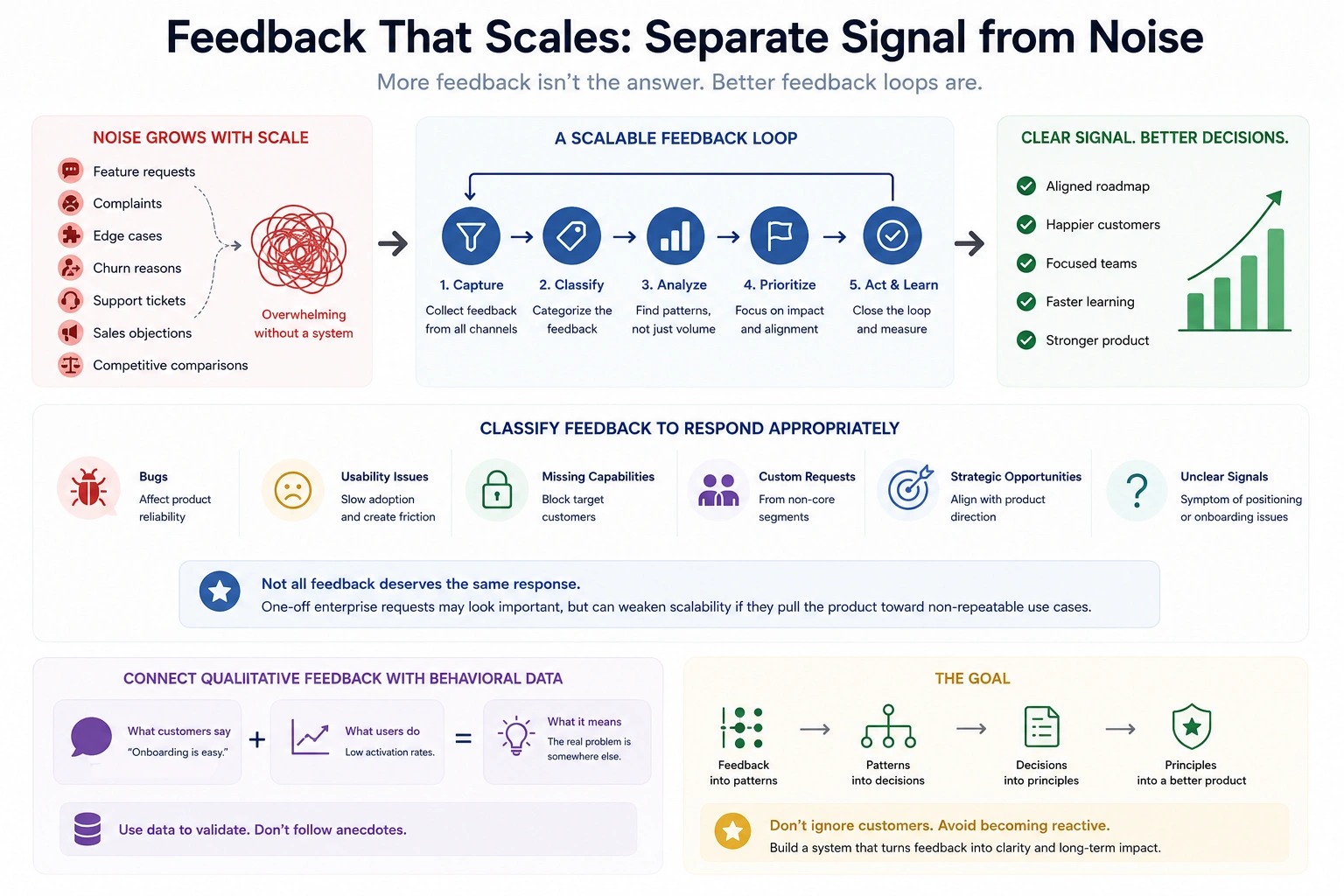
As a SaaS company grows, feedback volume increases. More customers means more feature requests, complaints, edge cases, churn reasons, support tickets, sales objections, and competitive comparisons.
This sounds helpful, but it can become overwhelming.
The scalable founder does not simply listen to more feedback. They build a system for interpreting feedback correctly.
Without a clear feedback process, loud customers dominate the roadmap. Sales escalations override product strategy. One-off enterprise requests appear more important than broad usability issues. Product teams confuse frequency with importance, or mistake revenue size for strategic relevance.
A scalable feedback loop should distinguish between several categories:
- Bugs that affect product reliability
- Usability issues that slow adoption
- Missing capabilities that block target customers
- Custom requests from non-core segments
- Strategic opportunities that align with the product direction
- Symptoms of unclear positioning or onboarding
This classification matters because not all feedback deserves the same response. A feature request from a large prospect may be commercially tempting, but if it pulls the product toward a non-repeatable use case, it can weaken scalability.
Founders should also connect qualitative feedback with behavioral data. If customers say onboarding is easy but activation rates are low, the product data deserves attention. If sales says a feature is critical but lost-deal analysis shows pricing or trust as the real barrier, the roadmap should not blindly follow anecdote.
The goal is not to ignore customers. It is to avoid becoming reactive.
A scalable product organization turns feedback into patterns, patterns into decisions, and decisions into product principles.
 Key Takeaways
Product scalability is not a single engineering project. It is the result of disciplined choices across product design, architecture, onboarding, pricing, and operations.
The most practical lessons for SaaS founders are:
- Scalability should be evaluated before growth pressure makes problems urgent.
- Customer flexibility is useful only when repeated patterns become configurable product capabilities.
- Onboarding must become repeatable, even if it remains high-touch for strategic customers.
- Architecture should be judged by its ability to support future product change, not only current traffic.
- Pricing and packaging must be enforceable by the product, not managed through hidden manual work.
- Feedback systems should separate strategic signal from customer-specific noise.
- The best scalability decisions preserve learning while reducing avoidable complexity.
Founders should not over-engineer too early. But they should be honest about which shortcuts are temporary and which are becoming part of the operating model.
Final Thoughts: Scalability Is a Design Choice, Not a Growth Stage
A SaaS product does not suddenly become scalable when the company hires more engineers, raises a larger round, or migrates infrastructure. Scalability emerges from hundreds of decisions about what to standardize, what to configure, what to automate, what to decline, and what to measure.
The strongest founders understand that scalability is not the opposite of speed. Done well, it protects speed. It prevents the company from becoming slower with every new customer, feature, and market segment.
The real question is not whether your product can grow. Most products can grow for a while through effort, urgency, and improvisation.
The better question is: when growth arrives, will your product become stronger because of it, or more fragile?